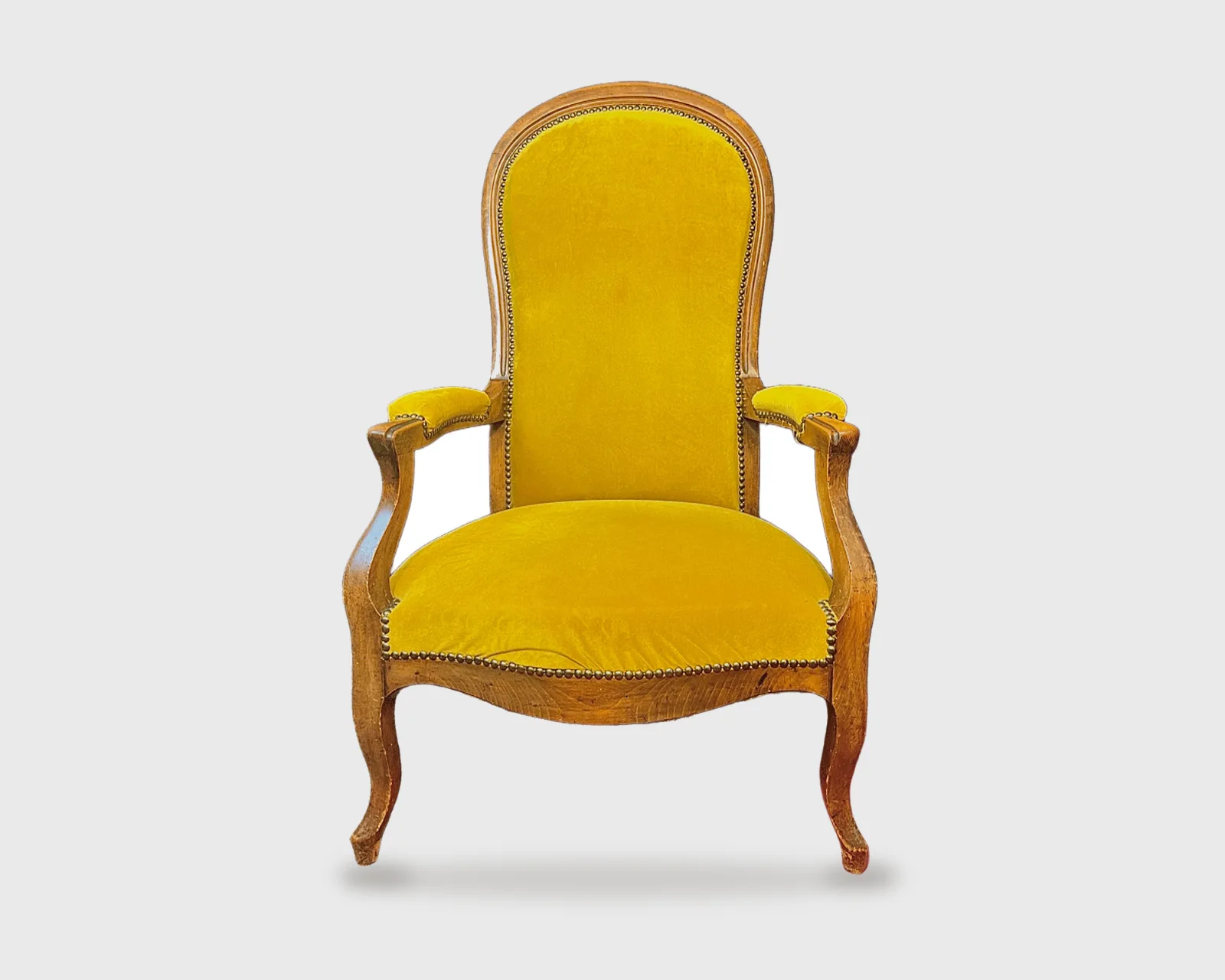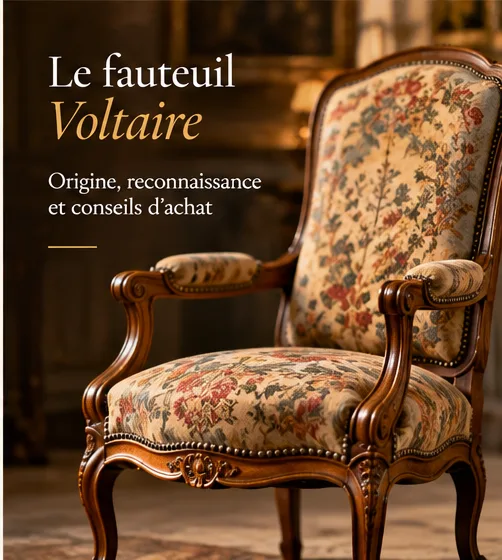
The Voltaire armchair is an armchair with a tall, curved back that tilts slightly backwards, set on a low and generously upholstered seat. It appeared in France during the Restoration (1815-1830) and became widespread under Louis-Philippe, at a time when comfort was becoming a central concern in furniture. The philosopher had nothing to do with it: Voltaire died in 1778, and the earliest written record of the name noted by the Trésor de la langue française dates from 1837.
Here is where this chair comes from, how to tell an antique Voltaire armchair from a reproduction, and what to check before buying one (frame, upholstery, restorations). See our fully restored Voltaire armchair.
A definition in a few words
The standard dictionaries agree on the essentials, and the essential feature is the back. The Larousse describes an “armchair with a tall back tilted backwards, which appeared under the Restoration”. The Trésor de la langue française calls it a piece fashionable under the Restoration, with a wide seat and a tall back that is slightly inclined and curved. The terminology database of the Office québécois de la langue française, under “antique furniture”, adds that the seat is low and that the tall back is curved.
In short, three features define the type:
- a tall back, which supports the back;
- a back that is slightly tilted and curved, following the spine rather than holding it upright;
- a low, upholstered seat, which invites you to sink in rather than sit up straight.
It is therefore above all a chair for resting, designed for comfort.
A chair born under the Restoration
Both the Larousse and the Trésor de la langue française date the appearance of the Voltaire armchair to the Restoration, that is, the reigns of Louis XVIII and Charles X. The model then became truly widespread under the July Monarchy. The Louis-Philippe style was driven by a concern for comfort and economy: its lines are heavier, and seats were given padding of horsehair or springs, sometimes with castors on the legs. The Voltaire armchair, low on its legs, deep in the seat and with a tall curved back, grew in popularity during this period.
This was also when furniture making began to industrialise: pieces were increasingly produced in series, with the help of machine tools.
Under the Second Empire the taste for comfort continued: seats were padded with buttoned upholstery and springs, and covered in brocades or rich velvets. The word remained in common use: in 1880, in Nana, Zola settles Gaga deep in “the only armchair, a red velvet voltaire”.
Why “Voltaire”?
The common noun comes from the name of the writer François-Marie Arouet, known as Voltaire (1694-1778). Yet Voltaire died in Paris on 30 May 1778, in his town house on the quai des Théatins, now the quai Voltaire: he never knew the chair that bears his name. The earliest written examples recorded by the Trésor de la langue française date from 1837, in the form “fauteuil à la voltaire” (in Le Constitutionnel, quoted by Stendhal in his Mémoires d'un touriste), then from 1844 with the phrase “to sit in one's voltaire”, from the pen of Delphine de Girardin. In French the word is often used on its own: people say “un voltaire” just as they say “une bergère”.
Why this name rather than another? It is often said to come from an image showing the philosopher seated in a large armchair, but no reference source confirms this, so it should be treated as a hypothesis.
Voltaire's own armchair does exist, and it is in the Musée Carnavalet in Paris. Dated around 1775 and stamped by Charles-François Normand, who became a master in 1747, it is made of carved and gilded beech, runs on castors, and is fitted with a tilting reading stand on the right arm and a swivelling writing tablet with a drawer on the left arm. The museum points out that, contrary to legend, Voltaire did not die in it. It is an eighteenth-century working chair, of an entirely different form from the nineteenth-century Voltaire armchair.
Recognising a Voltaire armchair
Faced with a chair, a few simple questions tell you whether the name is deserved:
- Is the back clearly taller than that of an ordinary armchair? This is the first sign.
- Is it tilted backwards and curved? A tall but perfectly upright back points to a different type of chair.
- Is the seat low and deep? A Voltaire invites you to sink in rather than sit upright.
- Which wood? Under Louis-Philippe, warm, dark woods were fashionable: mahogany, rosewood, burr walnut, cherry; pear and beech were sometimes ebonised.
Finally, remember that “Voltaire” describes a form, not a period. Dictionaries define it by its back and seat, not by a date of manufacture: the word alone therefore tells you nothing about a chair's age.
What the upholstery hides
The comfort of a Voltaire armchair depends as much on its upholstery as on its shape. Writing about an English chair of around 1845, the Victoria and Albert Museum in London explains that sprung upholstery developed in the 1820s, when iron springs became cheaper to manufacture. Coil springs gave seats more depth and resilience; they reduced the amount of horsehair needed without doing away with it, as a layer of stitched horsehair was still laid over the springs. In France, Louis-Philippe seats were likewise padded with horsehair or springs.
Upholsterers today still distinguish two families of upholstery:
- traditional upholstery, made of webbing, springs, vegetable fibre and horsehair, used mainly when re-upholstering antique seats;
- modern upholstery, made of foams and elastic webbing.
Both are found on antique Voltaire armchairs, because upholstery wears out and is redone several times over a chair's life. Neither is a fault in itself, but they are two different techniques, and it is reasonable to know which one you are buying.
What to check before buying
Choose a Voltaire armchair for its structure first and its fabric second. Before deciding, take the time to look at:
- The frame. Sit down and shift your weight a little: the chair should neither creak loudly nor wobble. Antique seats are assembled with mortise and tenon joints, sometimes reinforced with pegs; a loose joint can be reglued, but it is a job for a chair-maker that you should budget for.
- The wood. Look at the arms and legs, which take the most wear: cracks, chips, replaced parts, old insect damage. A well-executed restoration is not a problem; an undisclosed repair becomes one.
- The upholstery. Ask whether it is traditional or modern, and when it was last redone. A seat that sags on one side, or springs you can feel under your hand, means re-upholstery is due.
- The fabric and finish. New velvet or a renewed row of decorative nails are common restoration work. They say nothing about the age of the frame.
- Declared restorations. A serious seller states what has been redone: upholstery, fabric, varnish, wooden parts. Do not hesitate to ask.
- “Period” or “in the style of”. A “period” chair was made during the era whose name it bears; a chair “in the style of” takes up its forms later. Both have their place in a home, provided the description says so clearly.
Frequently asked questions
What is the difference between a Voltaire armchair and a Louis-Philippe armchair? The first is a type of chair, defined by its shape; the second is a style, tied to a period (1830-1848). The Voltaire armchair appeared under the Restoration and became widespread above all under Louis-Philippe; its name refers to the form, whatever the date of manufacture.
Did Voltaire ever sit in a Voltaire armchair? No. Voltaire died in 1778, several decades before the model appeared under the Restoration. His own armchair, kept at the Musée Carnavalet, is a working chair on castors, with a reading stand and a writing tablet, and an entirely different shape.
Should I be wary of a re-upholstered Voltaire armchair? No: upholstery is made to be redone. What matters is that the frame is sound and that the work carried out is described: type of upholstery, fabric, any repairs to the wood.
How can I tell whether a Voltaire armchair is antique? The name alone is not enough, since it describes a form, not a period. You need to examine the wood, the joints and the upholstery, and rely on what the description states. When in doubt, an outside opinion is always useful.
In conclusion
The Voltaire armchair is a comfortable seat born in the nineteenth century: a tall reclining back, a low seat, and a name borrowed from a philosopher who never knew it. To choose one well, look at its structure before its fabric, and ask what has been restored.
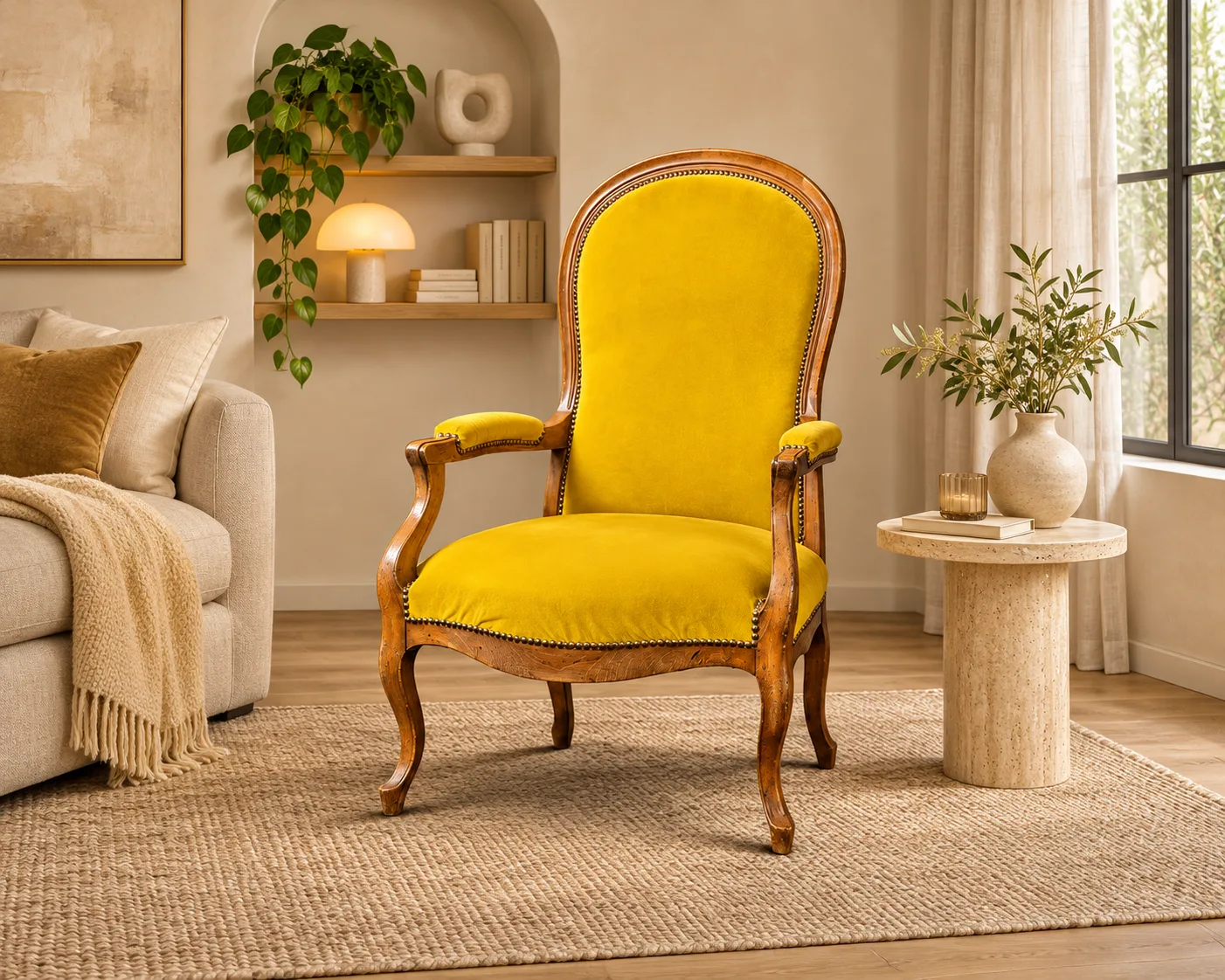
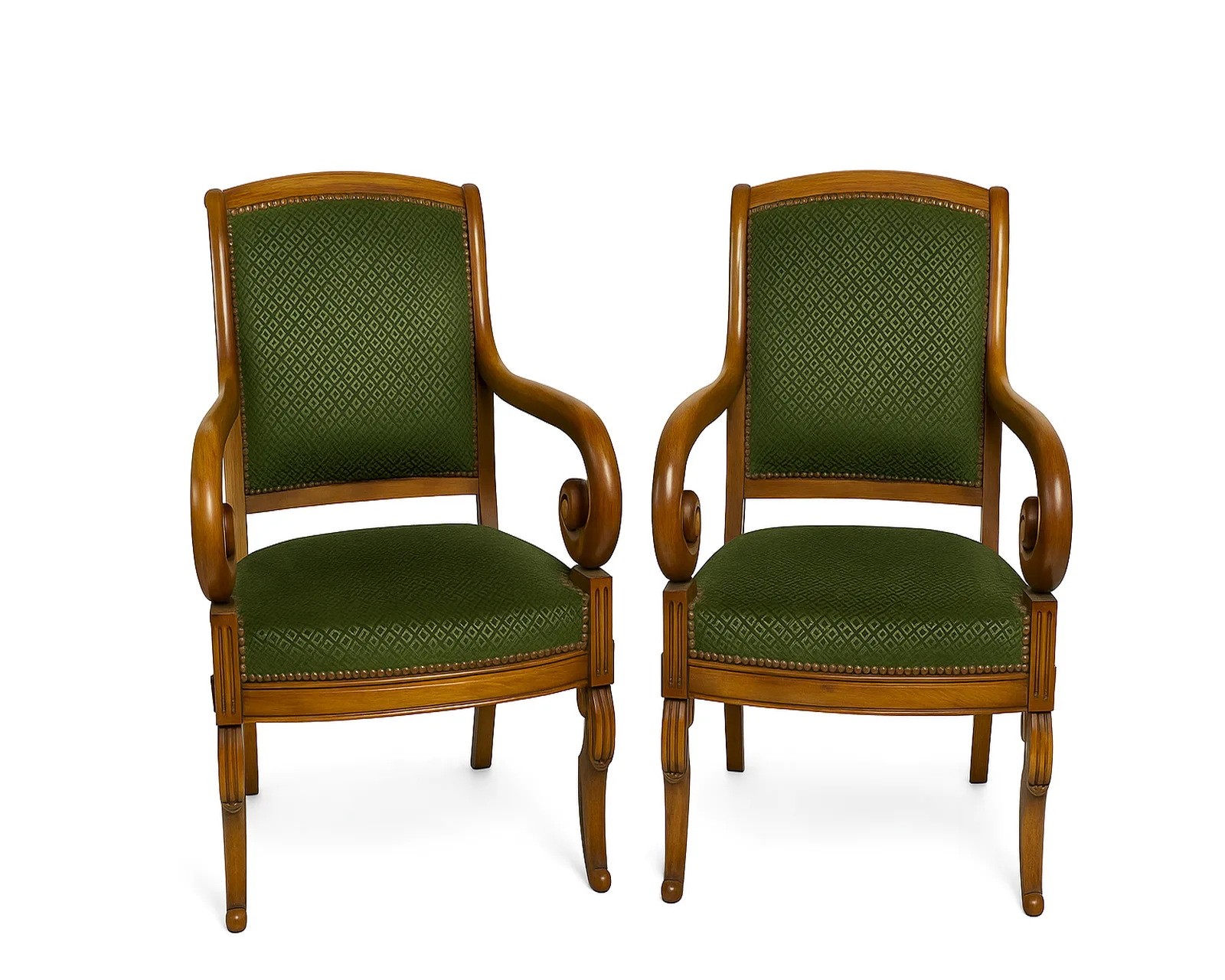
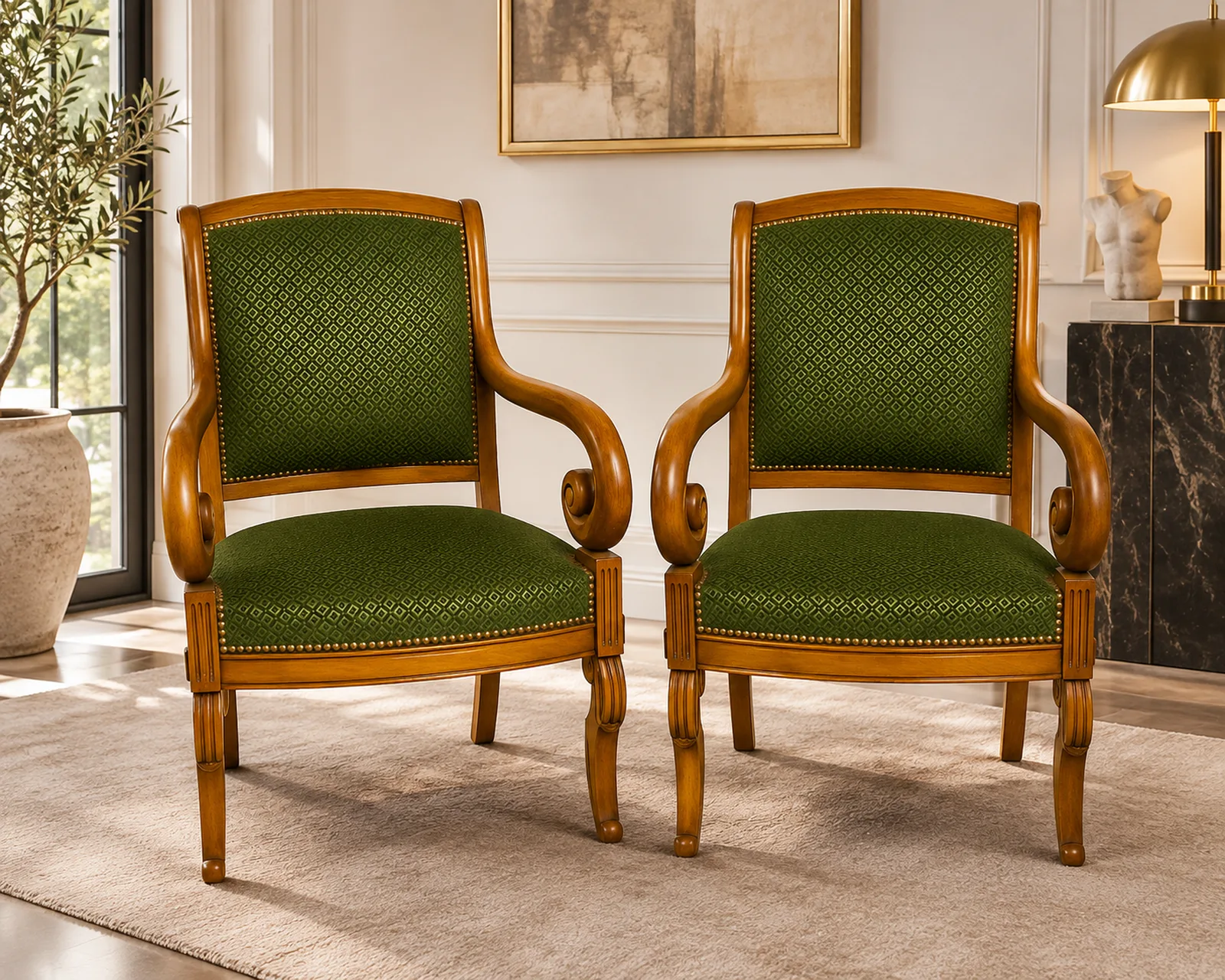
At the gallery, our fully restored Voltaire armchair, from the nineteenth century, has a tall, enveloping back, a deep seat and yellow velvet upholstery trimmed with a row of decorative nails. For a different silhouette, our pair of Empire-style armchairs in light wood and green velvet, made in France in the late twentieth century, has scrolled arms ending in a volute and fluted front legs. Browse all our seating in the furniture collection, and if you own an armchair whose history you would like to understand better, our expertise page explains how to submit it to us.