Looking after an antique clock day to day takes only a few simple habits: wind it regularly and gently, stand it perfectly level so that it beats evenly, never turn the hands backwards, and keep it away from any source of heat. Oiling and servicing are a job for a clockmaker: the UK's Institute of Conservation (Icon) recommends an inspection with fresh lubrication roughly every three years, and a full strip-down no later than eight years. Here is how a nineteenth-century French mantel clock with a Brocot escapement works, and how to keep it running.
The mantel clock, centrepiece of the nineteenth-century drawing room
The first table clocks with a round pendulum movement were made in Paris around 1750. The mantel clock, sometimes called the Paris clock, went on to enjoy enormous success towards the middle of the nineteenth century. Its popularity went hand in hand with the rise of the middle classes during the Industrial Revolution: standing on the drawing-room mantelpiece, the clock became a symbol of social success. Its spread rested on the mechanised production of movements and on decorative subjects reproduced in numbers.
On the mantelpiece, the clock was often part of a garniture: a set of matching objects, most commonly three, in which the clock is flanked by a pair of vases or candelabra. Garnitures became popular in the second half of the seventeenth century and remained in vogue throughout the nineteenth.
As for the "marble" of these clocks, the word should be read in the stonemason's sense: a compact limestone that takes a fine polish. Several dark-ground stones went by that name, such as Belgian black, discovered in Wallonia, Sainte-Anne from the Ardennes, veined with white, or portor with its gold-coloured veins. That limestone nature matters for cleaning, as we shall see.
The "Paris movement": a round mechanism made in two stages
The round movement was born in Paris around 1750. Its distinctive feature is its plates, the two discs between which the wheels turn: they are circular rather than rectangular.
In the nineteenth century it was made in two stages. Workshops in Franche-Comté and at Saint-Nicolas-d'Aliermont in Normandy supplied Paris makers with rough movements known as "mouvements en blanc" or "blancs-roulants". These were bare movements, which included in particular:
- mounted barrels, but without their mainsprings;
- the complete motion work;
- the going train and the striking train.
The anchor, pendulum and suspension were not yet fitted. The finishing clockmaker cut the escape wheel, which set the length of the pendulum, then completed the movement and fitted it into its case. In the early nineteenth century, around a hundred blancs-roulants left Saint-Nicolas-d'Aliermont for Paris each week, signed by Honoré Pons or François Douillon.
A striking clock generally has two springs housed in barrels: one drives the timekeeping, the other the strike. They are wound with a key from the front of the clock.
The Brocot escapement: the heart of the clock, on show
The escapement is the part that releases the wheel train one tooth at a time while keeping the pendulum swinging. It is what makes the tick. The Brocot escapement, also called the roller escapement, bears the name of a family of Paris clockmakers. It is most often attributed to Louis-Gabriel Brocot, and his son Achille Brocot (1817-1878) refined it. Sources disagree on the date of its invention, which they place in the first half of the nineteenth century, so we do not give a precise one.
It is a variant of the anchor escapement. Its particular features:
- the anchor carries two semi-cylindrical pins, which act both as locking surfaces and as impulse faces;
- the teeth of the escape wheel are cut in a saw-tooth shape;
- the design is robust and easy to make, and it was used in nineteenth-century French clocks.
This escapement is often revealed through an opening cut in the dial. You can then watch the anchor rock with every beat: the mechanism becomes part of the decoration.
The Brocot suspension: regulating from the dial
A clock pendulum hangs from the movement on a suspension spring. Achille Brocot devised the Brocot suspension, which lets the rate be adjusted by changing the length of that spring with a key turned in the dial. There is no need to open the clock to make it run faster or slower.
Achille Brocot founded the firm of Brocot & Delettrez in Paris with Jean-Baptiste Delettrez on 20 October 1851, and remained a partner until his death. An amateur mathematician, he also gave his name to the Stern-Brocot tree, a structure for approximating real numbers by fractions, useful in working out gear ratios.
Everyday habits: winding, setting, placing
Winding. Wind the clock regularly: at roughly the same time each day for a clock that needs daily winding, on the same day each week for an eight-day clock. Turn the key gently, steadily and fully. Count the turns needed and use that number as a guide. The danger is not "overwinding": it is rough winding that can cause costly damage.
Setting the time. Never turn the hands backwards without proper advice: to put the clock back, stop it instead and restart it once the time has caught up. Move only the minute hand, let the clock finish striking before going on, and avoid moving the hands forward by more than an hour or so. If the strike no longer matches the time shown, a clockmaker can put it right; do not leave the striking spring unwound to silence the clock.
Restarting. To set the clock going, move the pendulum about a centimetre to one side and let go, taking care not to push it too far, which could damage the mechanism.
Regulating. On a French clock with adjustment through the dial, make small corrections of half a turn and wait two or three days before judging the result. Do not expect quartz accuracy from a mechanical clock.
Placing. Avoid any heat source, including direct sunlight, and do not stand the clock on a mantelpiece above a working fire. Do not touch the dial with bare fingers: moisture and oils from the skin can damage it and remove painted or printed features.
The beat: a clock must stand level
A pendulum clock has to stand level. To the ear, a clock that is "in beat" gives an evenly spaced tick and tock; if the rhythm limps, it is "out of beat". Start by checking that it is level; if the beat is still uneven, a clockmaker can easily put it right.
Oiling, servicing, moving: the clockmaker's role
Do not oil it yourself. Lubricants deteriorate over time, even in good conditions. The Institute of Conservation recommends an inspection and re-lubrication roughly every three years, then a full strip-down and clean after five years and no later than eight. This is work for a professional: too much oil, or oil in the wrong place, causes damage, and household products must be avoided. Erratic timekeeping for no obvious reason, or a clock that stops before the end of its running time or no longer strikes fully, are all signs that it is time to see a clockmaker.
After a long stop. Stop the clock before going away. If it is to stand idle for more than a month, have it inspected and re-lubricated before starting it again.
Moving. Before moving a clock, secure the pendulum or take it out, then lift the piece by its sturdiest part, never by a handle, whose fixings may have weakened over time.
Cleaning the marble. Marble is made of calcium carbonate, which acids attack. Vinegar and acidic products should be avoided, and alcohol and acidic liquids corrode the surface. Gentle dusting is all you should do; for stained marble or gilt bronze, ask a conservator.
Frequently asked questions
How often should an antique clock be serviced? The UK's Institute of Conservation recommends an inspection with re-lubrication roughly every three years, and a full strip-down and clean no later than eight years. A clock that stops, strikes badly or keeps erratic time should be seen sooner.
Can I oil my clock myself? No. Too much oil, or oil in the wrong place, damages the mechanism, and household products are unsuitable. Oiling is part of a service, best left to a clockmaker.
How can I tell whether my clock is level? Listen: the tick and the tock should be evenly spaced. If the rhythm limps, the clock is out of beat: first check that it is level, then, if need be, take it to a clockmaker.
Can a clock stand on a fireplace that is in use? It is best avoided. The heat of a fire, like direct sunlight, is not recommended for an antique clock. A decorative fireplace, a console table or a sideboard are all good places.
How do I move a clock without damaging it? Secure the pendulum or take it out, then carry the clock by its sturdiest part, never by a handle. Once in place, check that it stands level and beats evenly.
A Brocot escapement clock at the gallery
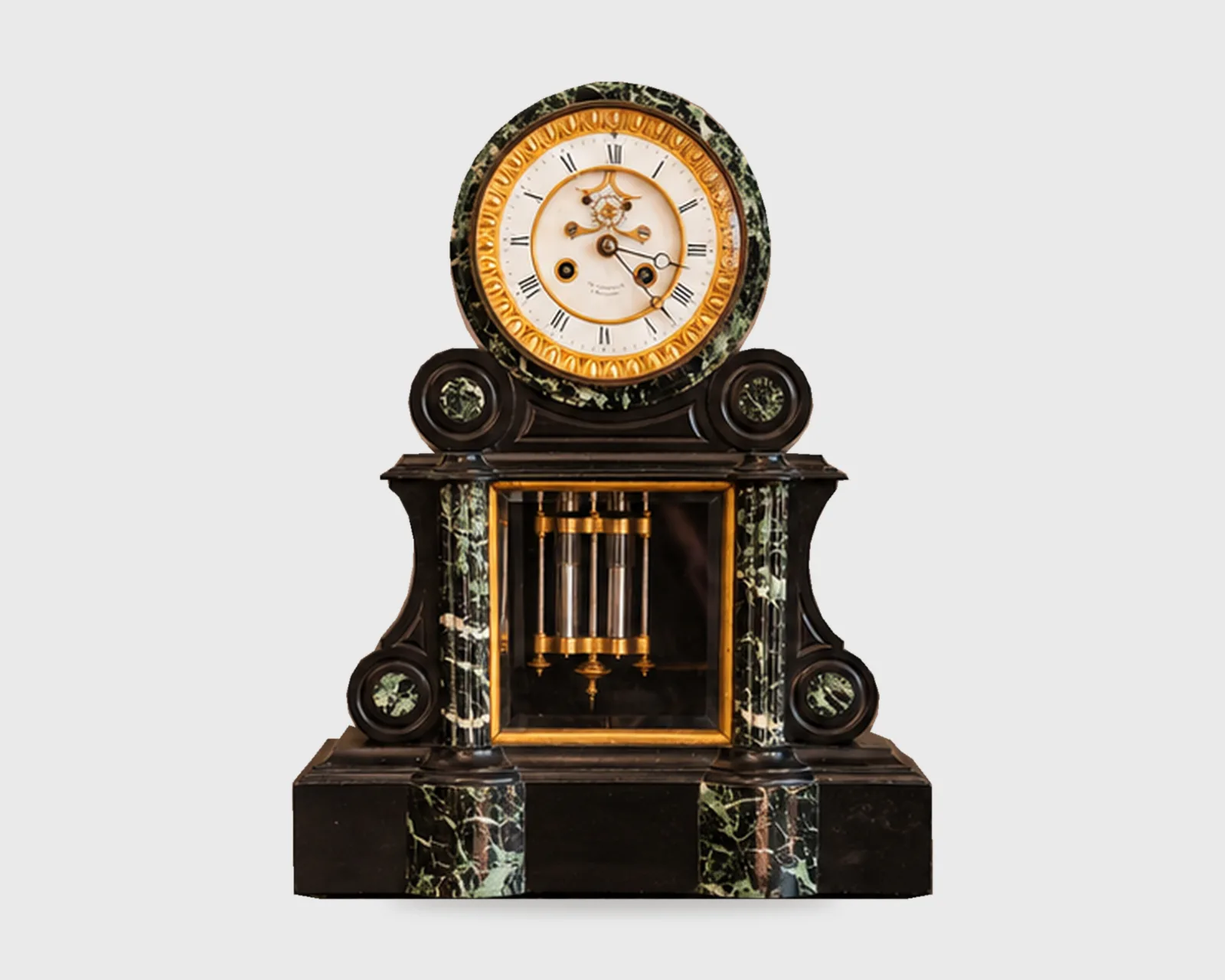
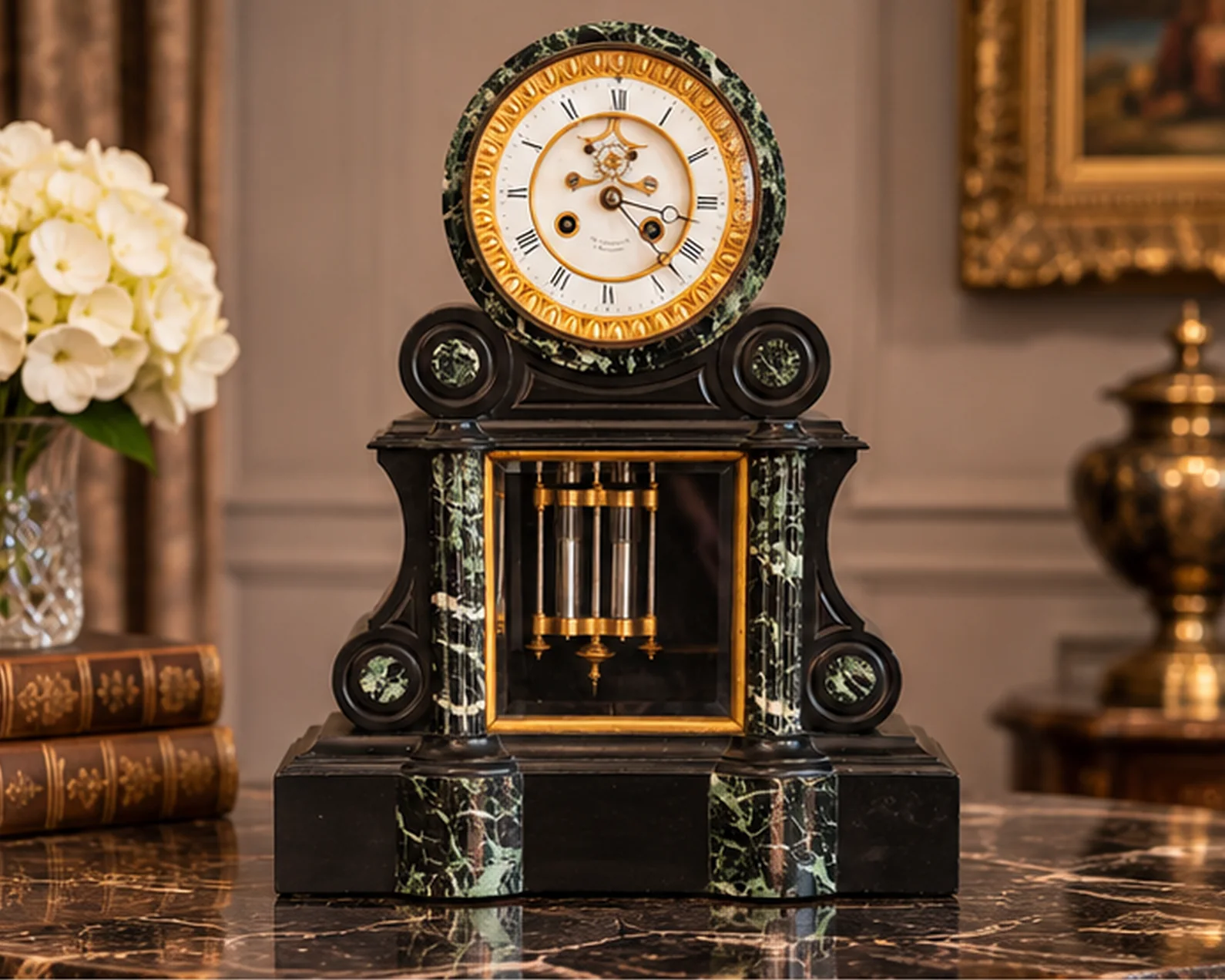
We currently have a Napoleon III clock in black and green marble: a round white enamel dial with Roman numerals signed "H. Tardieux à Marseille", a visible escapement at the centre of the dial, a four-tube "mercury" pendulum visible below the dial between two green marble columns, and a strike on a bell. It is in working order, stands 46 cm high and weighs 22.6 kg. You will find more pieces in our decorative arts collection. If you own a clock and would like to know more about it, our appraisal service is here to help.