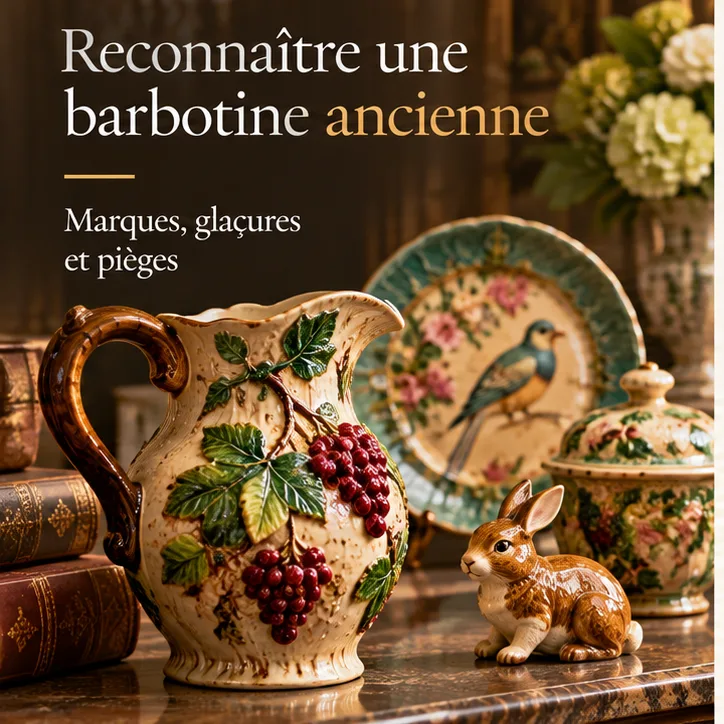
How can you tell whether a piece of barbotine is antique? No single clue is enough on its own: what matters is how several observations fit together. Translucent coloured glazes that bring out moulded or modelled relief, a consistent weight and underside, a genuine mark and plausible wear all point to a 19th-century piece; a piece that is too light, a lacklustre glaze or a mark half rubbed away “to look old” should, on the other hand, put you on guard.
Here are the points we look at in the gallery when reading these ceramics, a little history to place them, and the most common pitfalls.
Barbotine, majolica: what are we talking about?
The word first has a technical meaning. The Trésor de la langue française defines barbotine as potter’s clay thinned with water and used to attach applied ornaments to a piece. By extension, it refers to pottery made by this process and decorated with ornaments in relief. This second sense is the one collectors use: vases, jardinières, jugs and dishes covered in flowers, foliage, animals and figures in relief.
In English these same objects are called majolica, and in France people often say “majolique”. The term can mislead: it recalls Italian Renaissance maiolica, painted over an opaque white glaze. Nineteenth-century majolica is something else. The Victoria and Albert Museum in London describes it as transparent lead glazes, coloured with metal oxides, painted directly onto buff earthenware and then fired.
A fashion born in London in 1851
The story begins in England. The Minton factory at Stoke-on-Trent first showed pieces of this kind to the public in 1851, the year of the Great Exhibition in London. Their glazes had been developed in 1849 by a Frenchman, Léon Arnoux (1816–1902), the son of a Toulouse porcelain manufacturer, trained at Sèvres, who became Minton’s art director. Above all, these pieces set out to emulate the work of the 16th-century French potter Bernard Palissy, his glazes and his modelling. Arnoux himself held that this pottery, when decorated with transparent coloured glazes, ought to be called “Palissy ware”; it was the name majolica, however, that stuck, and he was already noting that it was applied indiscriminately to all kinds of fancy coloured pottery.
Success was immediate. According to the V&A, Minton was the only British ceramic manufacturer to receive a Council Medal from the Great Exhibition jury, and Queen Victoria gave her name to a large wine cooler now in the museum. Arnoux recalls the sensation Minton’s pieces created at the 1855 Exposition Universelle in Paris. The V&A places the great vogue for majolica between 1850 and 1880.
One detail matters to collectors: imitation goes back a long way. In a text published in 1877, Léon Arnoux wrote that Wedgwood, George Jones and a few other makers “of less importance” were reproducing it more or less successfully. Antique barbotine is therefore not necessarily Minton, and a piece in the Minton manner is not necessarily antique.
The great French factories
In France, the genre was taken up by many faience factories. A few landmarks, without claiming to be exhaustive:
- Sarreguemines, in Lorraine, added majolica to its production in the 1860s, according to the Majolica International Society. It is known for humorous character jugs and for a pattern of fruit on a bed of moulded yellow leaves, made well into the 20th century. When the town became German after the war of 1870, the firm built two new factories in France, at Digoin and Vitry-le-François.
- Choisy-le-Roi, near Paris, was run from 1863 by Hippolyte Boulenger. The same society regards its majolica as the finest in France, made from the early 1860s until 1910 and acclaimed at the 1878 Paris Exposition Universelle. Among its works are monumental bird vases modelled by Paul Comolera and Louis-Robert Carrier-Belleuse. After the war, Sarreguemines workers who refused German nationality joined the factory.
- Vallauris, finally, is close to home for us on the Côte d’Azur. In the 19th century, Jacques Massier’s workshop began producing artistic pieces. On their father’s death, Clément Massier and his brother Delphin Massier took over the family business together; Clément won a gold medal at the 1889 Exposition Universelle and had the painter Lucien Lévy-Dhurmer as artistic director from 1887 to 1895. The Musée Magnelli, the ceramics museum in Vallauris, notes that the Massier workshops trained many ceramists, who carried on the techniques of metallic lustre and barbotine.
Reading the material: glazes, relief, weight
Before turning a piece over, look at it for a long time from the front. Three questions guide the examination.
Do the glazes have richness? On coloured-glaze majolica, the colour is carried by a transparent glaze: it lets the form beneath it show and brings out the relief. The Majolica International Society notes that the glaze on copies lacks the richness of true majolica, and that a dull, heavy or overpainted glaze does a piece no favours.
Is the relief properly built? By definition, barbotine combines a body with applied ornaments, attached with thinned clay. Flowers, leaves, animal-shaped handles: look at how these elements join the body, how crisp the veining is, how the petals overlap. Relief that is soft, clogged or uniformly smooth calls for a closer look.
Is the weight consistent? According to the same society, copies are lighter than genuine pieces. It is a relative clue, which requires having handled reference pieces, but it is often the first thing to raise a question.
The underside and the marks
The underside of a piece of barbotine has a great deal to tell. For majolica in general, the Majolica International Society observes that the underside is almost always glazed, often in pink, blue or green, sometimes white; an unglazed base calls for caution. It advises learning to recognise these underside glazes, which are useful when a piece bears no mark.
When there is a mark, read it methodically:
- Sarreguemines: early pieces bear an impressed “SARREGUEMINES”, sometimes with “MAJOLICA” above it; later pieces carry a stamp in heavy script.
- Choisy-le-Roi: a stamped “Choisy le Roi” or “Choisy”, sometimes with the letters “HB”, which are attributed to Hippolyte Boulenger.
- Minton and Wedgwood used date symbols indicating the year of manufacture. The British diamond registration mark, by contrast, gives the date the design was registered, which does not tell you when that particular piece was made.
- Massier: a Massier mark does not guarantee 19th-century manufacture. Jérôme Massier fils’s workshop was taken over in 1909 by his daughter and son-in-law, then by their son Jean Clergue, who used the “J MASSIER VALLAURIS” stamp until 1953; and after Clément Massier’s death, his daughters took over his business and reissued his works.
Finally, the Majolica International Society points out that a factory cannot be identified from the artist’s name alone.
The most common pitfalls
- The mark as sole proof. The Majolica International Society reports marks on reproductions partly rubbed away to look old. A mark should always be weighed against the material, the weight and the underside.
- The honest copy turned doubtful. Reputable makers today mark their majolica with their own factory name; a piece of recent manufacture whose mark seems to have disappeared therefore calls for caution.
- Recent copies. The same source reports that recently made cobalt-ground jugs have fooled many knowledgeable collectors, and even dealers.
- Repairs. It also warns against repaired pieces, which an inexperienced buyer does not always spot. Examine the piece in good light, especially where handles and relief elements join the body.
- Wishful thinking about a name. A piece in the manner of Minton or Massier is neither Minton nor Massier until solid evidence establishes it. The genre was imitated very early on.
Frequently asked questions
Can unmarked barbotine be antique? Yes. The Majolica International Society stresses that anonymous pieces can be very charming and should never be overlooked. That is why it recommends learning to read underside glazes and overall workmanship rather than relying on the stamp alone.
Are barbotine and majolica the same thing? In collectors’ usage, essentially yes: “barbotine” is the French word, taken from the process of attaching relief ornaments; “majolica” is the English term. Neither should be confused with Italian Renaissance maiolica, painted over an opaque white glaze.
Does a prestigious mark prove age? No. There are half-erased marks on reproductions, stamps used late, such as “J MASSIER VALLAURIS” until 1953, and reissues. A mark is one clue among others.
Are chips and cracks a sign of age? Not in themselves: a recent piece can be damaged, and an old one can be intact. Above all, the Majolica International Society points out that chips, cracks that go right through and crazing may be hard for a collector to accept, and that a heavy, overpainted glaze does a piece no favours.
Where should I start when examining a piece? With the front, in good light: the richness of the glazes, the construction of the relief, the joins of the applied elements. Then the weight, in the hand. Then the underside and the mark, if there is one. And, if in doubt, an outside opinion.
In conclusion
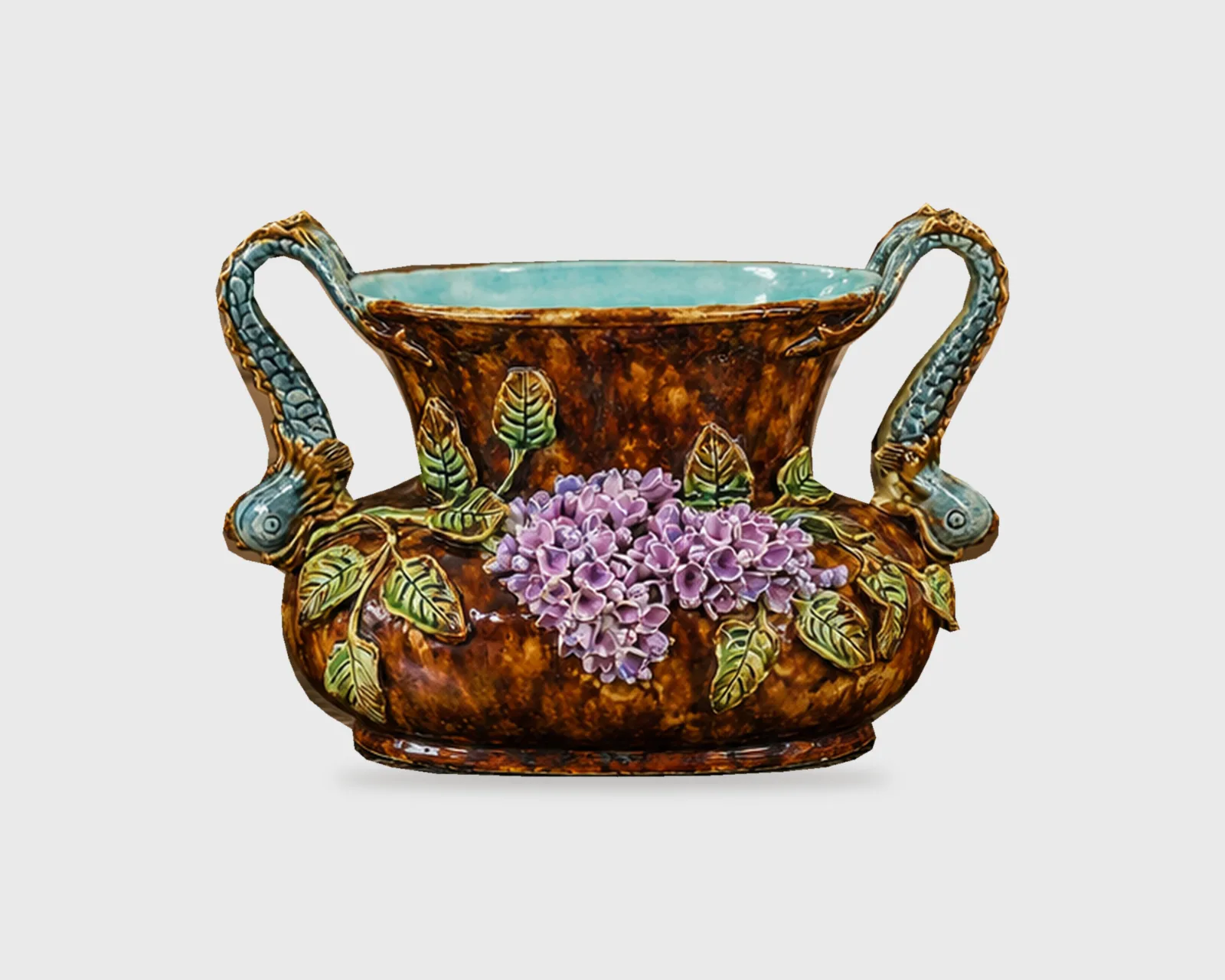
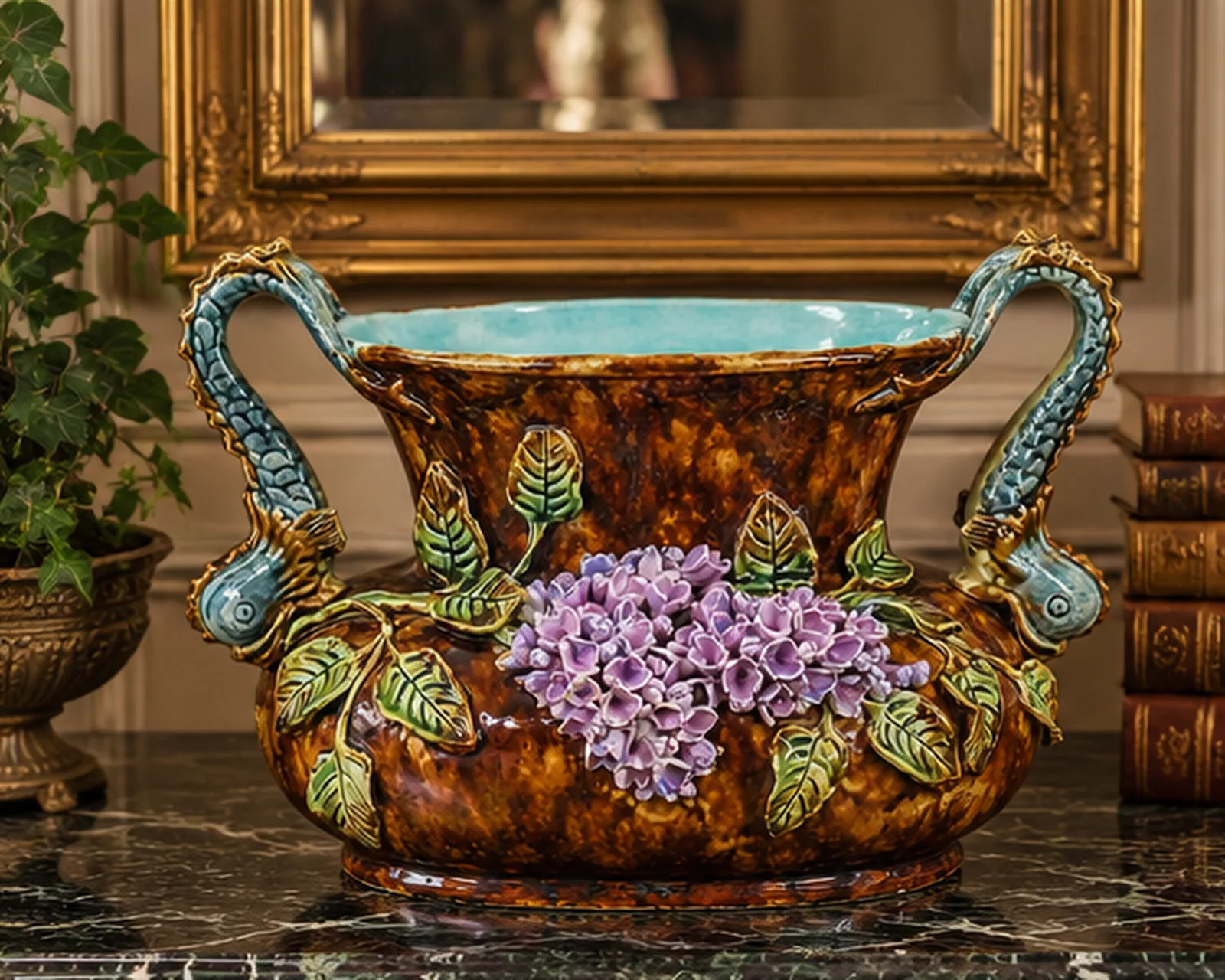
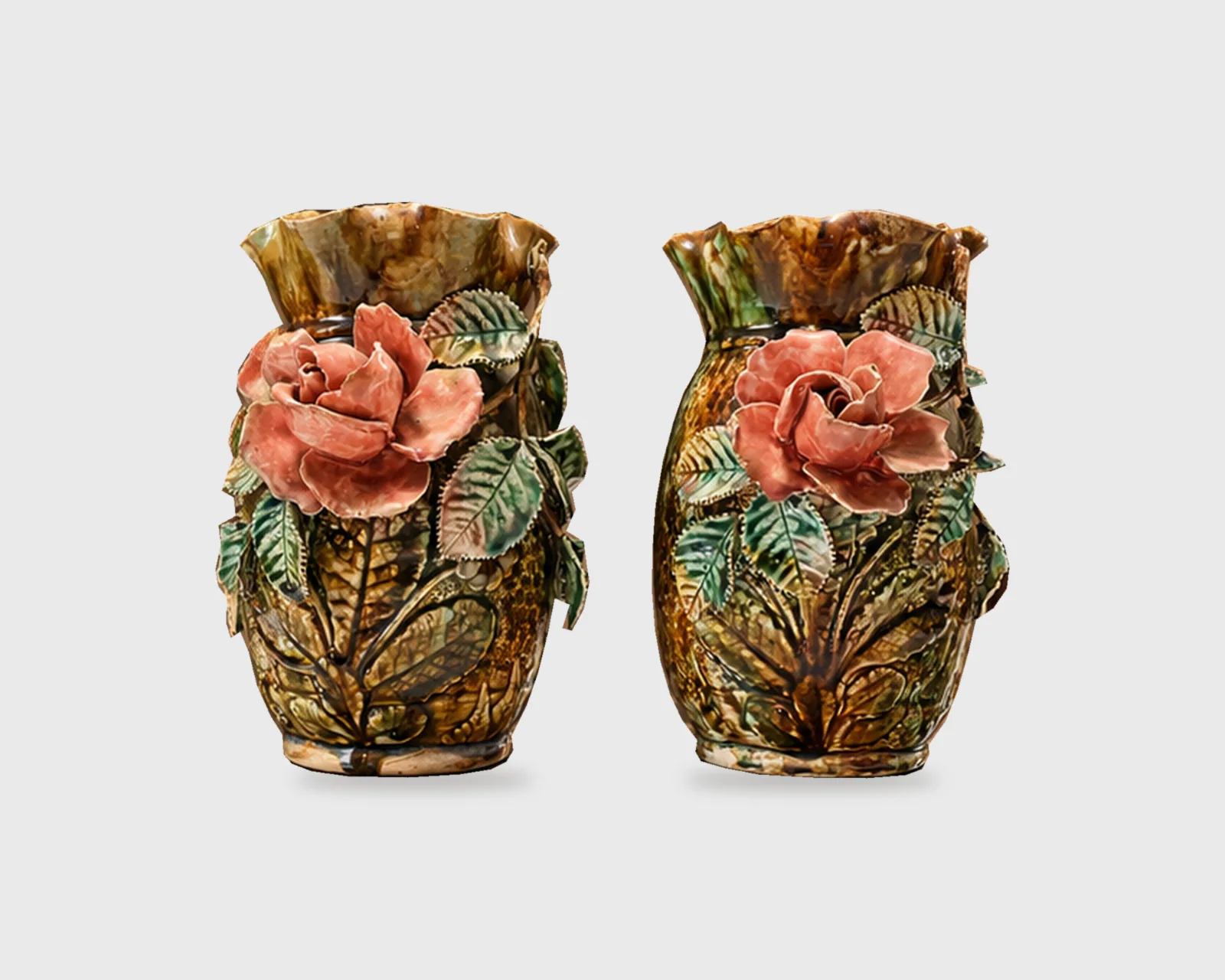
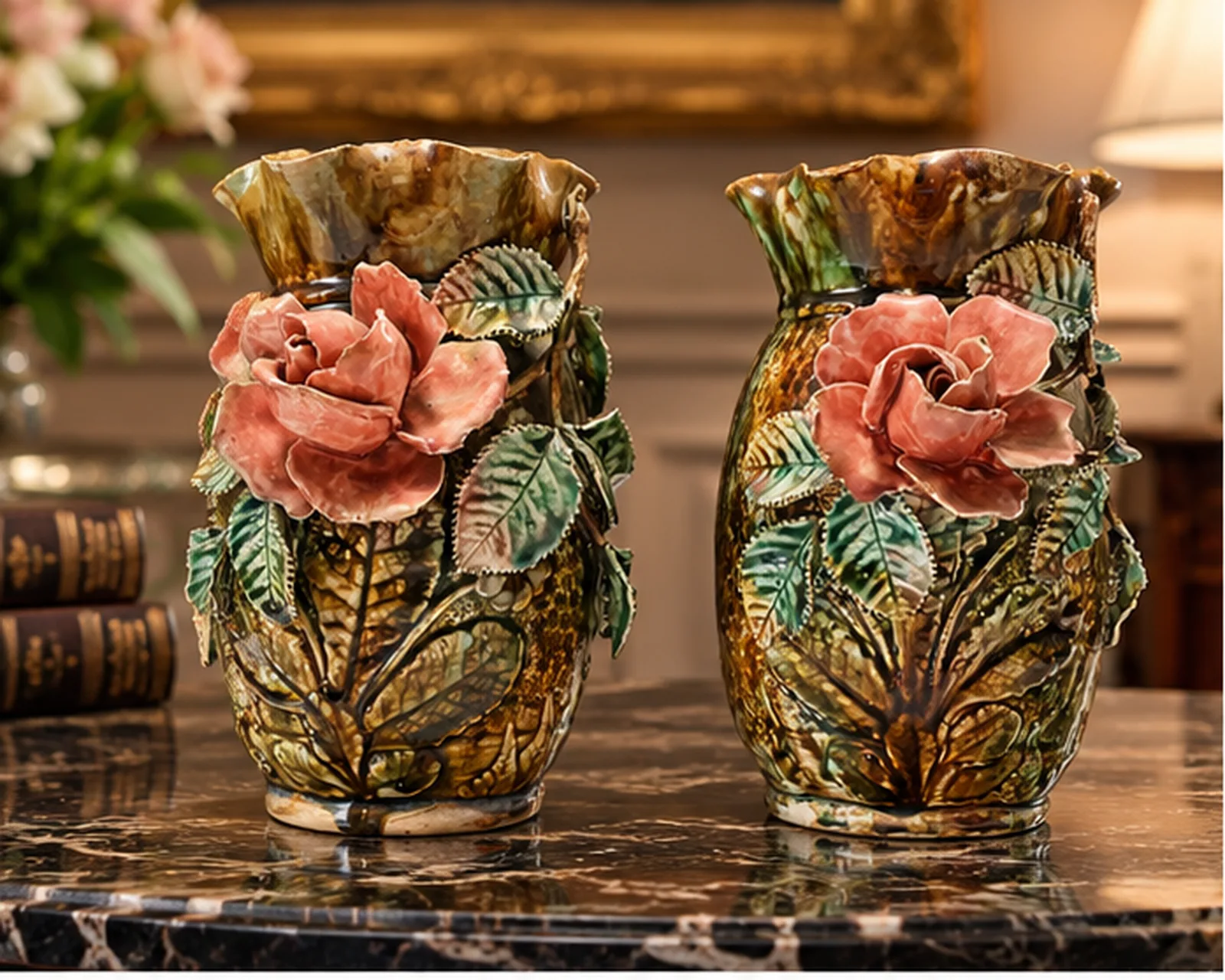
Recognising antique barbotine means combining several readings: glaze, relief, weight, underside, mark, and the history of the factories. In the gallery, two pieces illustrate this vocabulary well: a barbotine jardinière with dolphin handles, on a mottled brown ground with clusters of lilac modelled in high relief and a turquoise interior, and a pair of barbotine vases with roses in relief, with wavy necks and roses modelled petal by petal. More ceramics await you in our decorative arts. And if you have a piece of barbotine at home that you would like to know more about, our appraisal service is here to help.