A “period” Louis XV commode was made in the 18th century, while the taste was still new; a Louis XV-“style” commode takes up its forms later, most often in the 19th and 20th centuries. The silhouette will not tell you which is which, because the best copies reproduce it faithfully: the answer lies in how the piece was made – the carcass, tool marks, screws and nails, mounts, finish and the maker's stamp. No single clue is decisive; it is the way they agree, checked by a trained eye, that allows a conclusion.
Period or style: two words, two realities
In the language of furniture, “Louis XV period” refers to a date of manufacture: the piece was built while the style was current. “Louis XV style” refers only to an appearance: the piece borrows the forms and ornament of the period, whatever its actual date.
The Louis XV style only roughly matches the king's reign (1715–1774). It developed above all in the second quarter of the 18th century and is often called rocaille or rococo; the rococo furniture gathered by the J. Paul Getty Museum in its reference catalogue runs from the mid-1730s to about 1760. Then, between 1750 and 1774, came the Transition style, which moved away from the excesses of rocaille and paved the way for the Louis XVI style.
A style piece is not a fake. It is an honest creation that uses an older vocabulary without claiming to be old. Faking begins when a recent piece, or an assemblage, is passed off as period work.
The rococo commode: bombé and tombeau
The commode is a young form in the history of furniture: the first examples appeared in France in the 1690s, called at first “bureaux” and then “bureaux en commode”, and the word “commode” took hold from 1708.
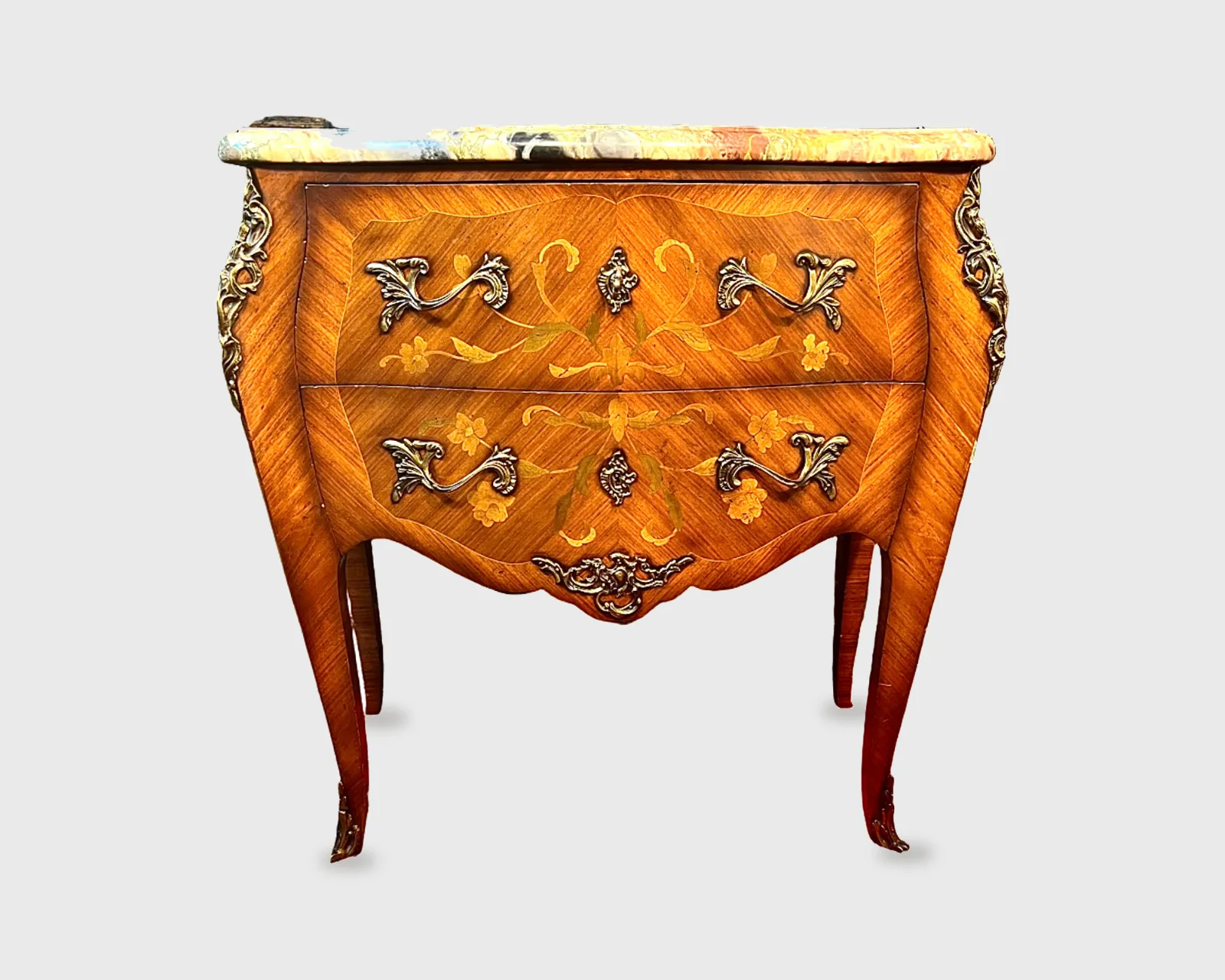
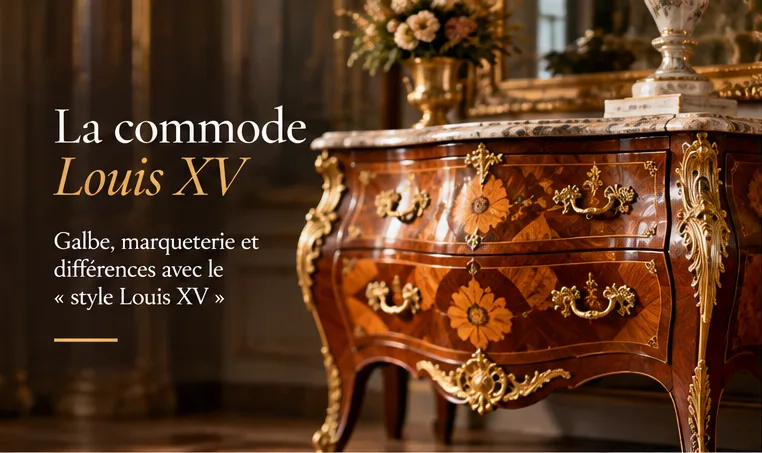
Under the Régence, the tombeau commode has every face bombé, three tiers of drawers and short feet. Under Louis XV the piece grows lighter: it rises on long, slender curved legs and usually has just two drawers. It is called galbée, or bombé, because its forms play on concave and convex curves.
Small two-drawer commodes with concealed rails were among the most widely produced pieces of the period; their mounts run from one drawer to the next until the division between them disappears. Asymmetry, reappearing for the first time since the Middle Ages, shows in these small commodes, often asymmetrical yet still balanced. Among the variants of the period is the so-called sauteuse commode.
Veneer, marquetry, mounts and marble
A fine Louis XV commode is cabinetmaker's work: a carcass covered with sheets of precious wood. Oak was then replacing fir for carcasses. The favoured timbers were tulipwood (bois de rose), kingwood (bois de violette) and amaranth, chosen for their brilliance. Marquetry had at first given way to frisage, which plays on the grain of the wood in geometric patterns; it returned around 1745, often with bouquets of flowers and musical instruments.
The gilt bronze mounts are placed on the apron, at the corner chutes, as handles and as framing mouldings. In the 18th century they were finely chased and mercury-gilt, with the shells, foliage and water motifs typical of rococo.
The marble top is shaped to follow the outline of the piece. On a commode by Bernard II van Risenburgh at the Getty (about 1740), it is a slab of brèche d'Alep cut exactly to the shape of the top, with a moulded edge.
All of these features – bombé form, marquetry, mounts, marble – appear on style commodes too. They tell you the style, not the date.
The maker's stamp and the JME mark: a clue, not a proof
The master menuisier-ébéniste struck his estampille on his furniture: an incised mark, applied cold with a soft-iron punch called a maindron, roughly 2 to 5 cm long, giving his full name or initials. The requirement was a fiscal measure, intended to monitor workshop output. Several edicts had prescribed it to no effect, including one of 1744; it was the edict of 20 April 1751 that actually took effect. The Revolution abolished the guilds in 1791, although some families went on stamping part of their output into the early 19th century.
Next to the master's name one often finds the JME mark, for jurande des menuisiers-ébénistes. On the Getty's Van Risenburgh commode, the “B.V.R.B.” stamp is struck on top of both rear stiles, each time flanked by JME marks. Struck at the top of the carcass, these marks are easily overlooked: some were only spotted during a conservation examination.
Yet the stamp remains a clue, not a proof. The Getty holds a commode bearing genuine “N. PETIT”, “DELORME” and “JME” stamps that turned out to be an assemblage from the second half of the 19th or the early 20th century, reusing pieces of a stamped 18th-century commode. The museum describes it as an intentional fake.
What the inside of the piece reveals
The technical entries in the Getty catalogue show which construction clues made it possible to date these pieces.
- Saw marks. On the Getty assemblage, the drawer bottoms carry the marks of a large rotary saw, of a kind not invented until the mid-19th century.
- Screws and nails. The same commode has machine-made, round-headed screws with conical points, of a type mass-produced from around 1850, and wire nails, not widely adopted until the later 19th century.
- Hidden timbers. Its drawer backs are red oak, a species native to the Americas and unlikely to have been used in 18th-century Paris.
- Joints. Saw kerfs that do not line up with the present dovetails show that these were recut.
- Mounts. Their chasing is consistent but rather mechanical; X-ray fluorescence analysis of the metal places them most likely between about 1900 and 1938.
- Finish. On the lacquered Van Risenburgh commode of about 1740, the original layer is bound in a sandarac-based spirit varnish; bleached shellac appears only in later restoration coatings.
A genuine piece may also have been altered. Another Van Risenburgh commode at the Getty, a commode à vantaux (with doors) of the 1730s stamped “B.V.R.B.”, carries mounts that all date from the late 19th or early 20th century: metal analysis, markedly less refined chasing and, on X-rays, old filled holes that do not match the present screws proved it. On the commode of about 1740, the escutcheon of the lower drawer is likewise a late 19th- or 20th-century replacement. Such interventions must be known and described.
Why the Louis XV style was copied so widely
The Second Empire style drew on many earlier styles, including Louis XV and Louis XVI, to the point that some called it a “pastiche style”. Workshops combined traditional techniques with industrial processes: the mechanical saw, router and gouge handled repetitive work, while handwork was kept for finishing. Electrotyping made it possible to multiply imitation bronzes. In the faubourg Saint-Antoine, the Paris district of furniture workshops, the flood of orders led craftsmen to reproduce existing motifs rather than innovate.
Production continued into the 20th century: the mounts on the Getty assemblage most likely date from 1900–1938. A well-made style commode has nothing to be ashamed of in its date; it simply needs to be described as what it is.
Frequently asked questions
Is a stamped commode necessarily period? No. A stamp shows that a piece of wood passed through a master's workshop, not that the whole piece left it intact. The Getty holds a commode from the second half of the 19th or the early 20th century built with pieces of wood bearing genuine stamps. The mark must always be weighed against the construction.
What does the JME mark mean? JME stands for jurande des menuisiers-ébénistes. The mark often accompanies the master's stamp on furniture from the second half of the 18th century, after the 1751 edict made stamping effectively compulsory.
What is the difference between a tombeau commode and a Louis XV commode? The tombeau commode, typical of the Régence, is bombé on every face, with three tiers of drawers and short feet. The lighter Louis XV commode stands on long, slender curved legs and usually has only two drawers.
Do replaced mounts mean a commode is no longer period? Not on their own: the Getty still dates to the 1730s a Van Risenburgh commode whose mounts all date from the late 19th or early 20th century. But the replacement must be identified, because it changes how the piece is read.
Where should I look first? At the top of the carcass and the stiles, where the stamps on the commodes mentioned here are struck, then in the drawers: saw marks, joints, timbers, screws and nails.
In conclusion
Telling a period Louis XV commode from a style one means moving from appearance to construction. Bombé form, marquetry and mounts tell you the style; wood, tools, joints and metal tell you the date.
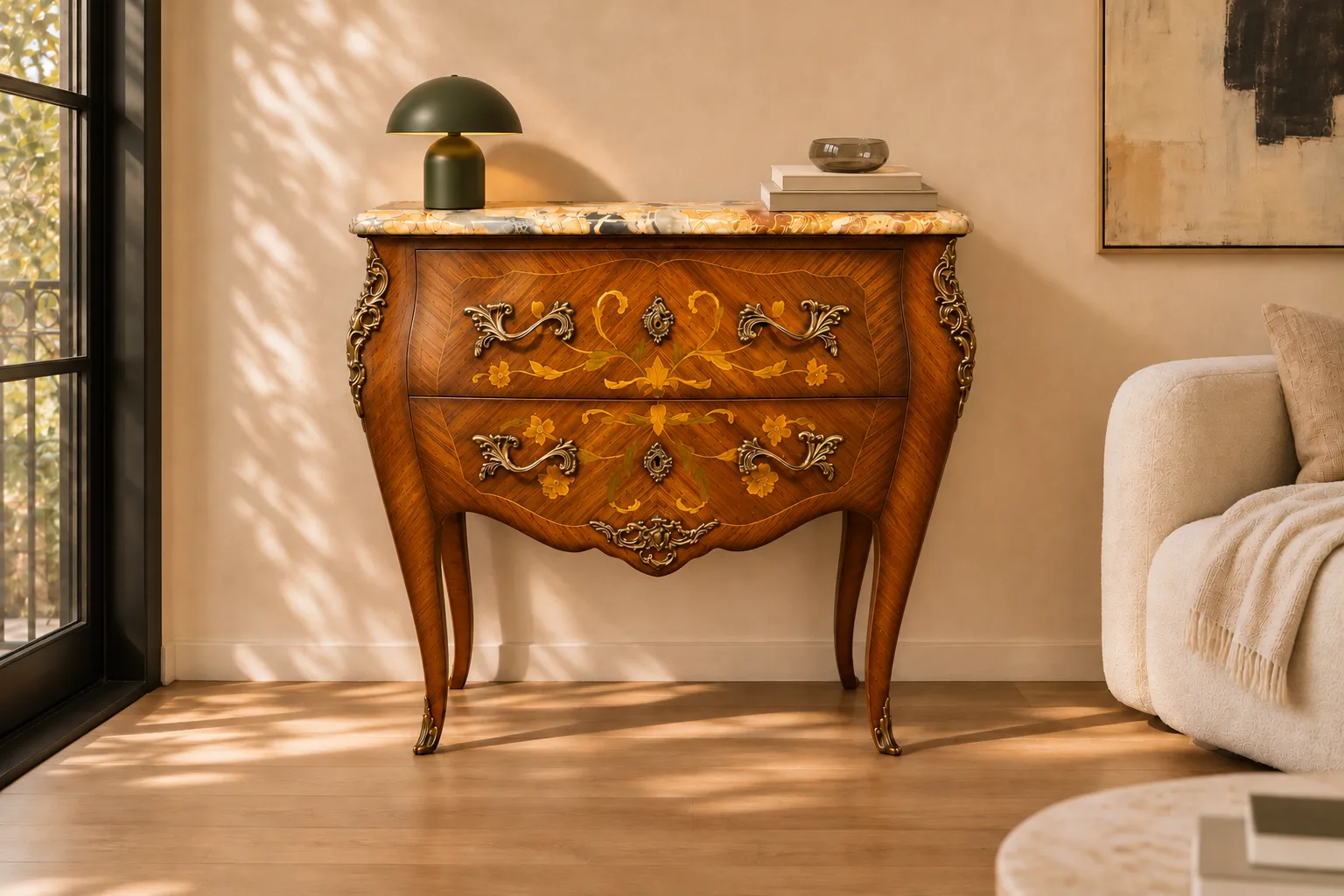
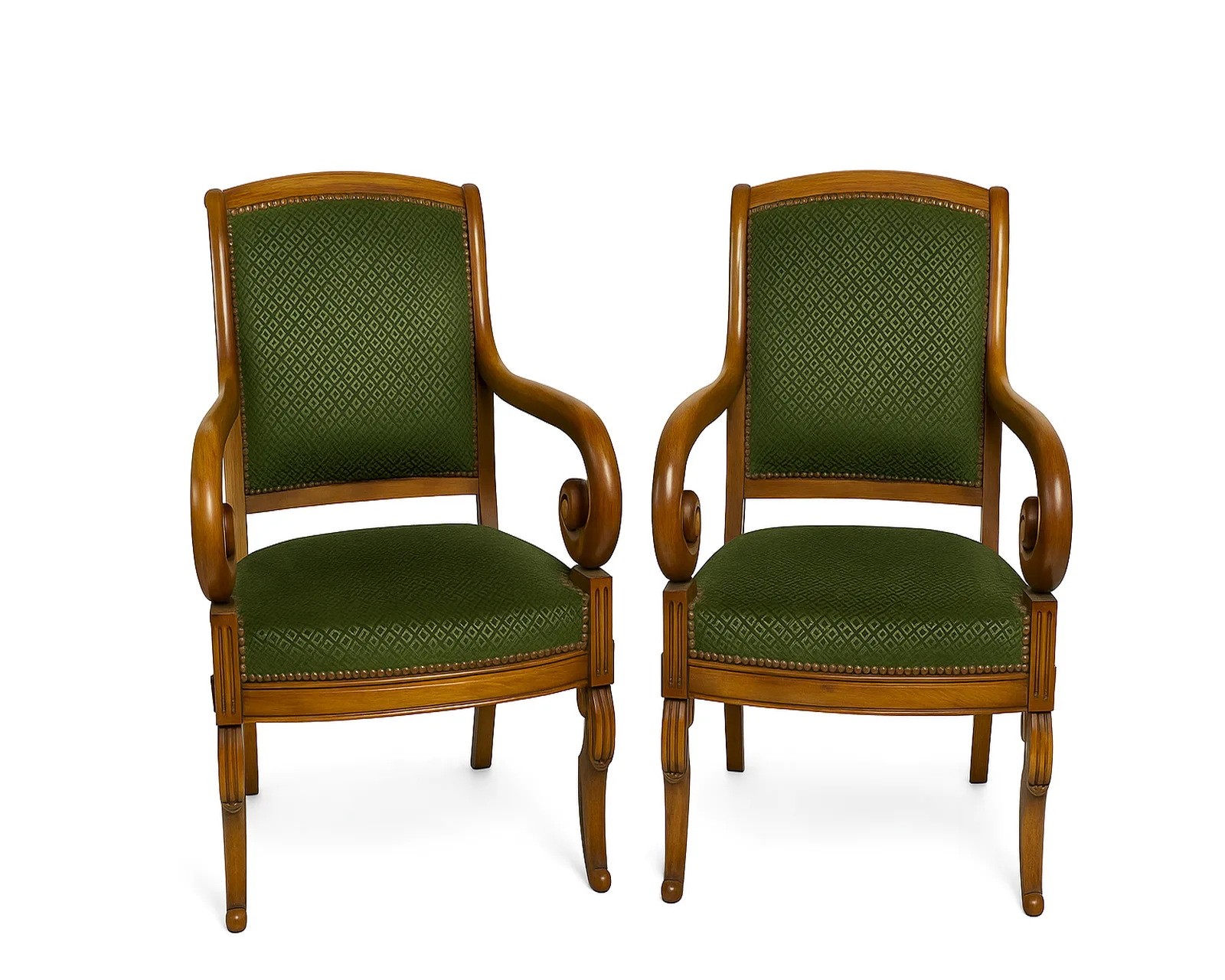
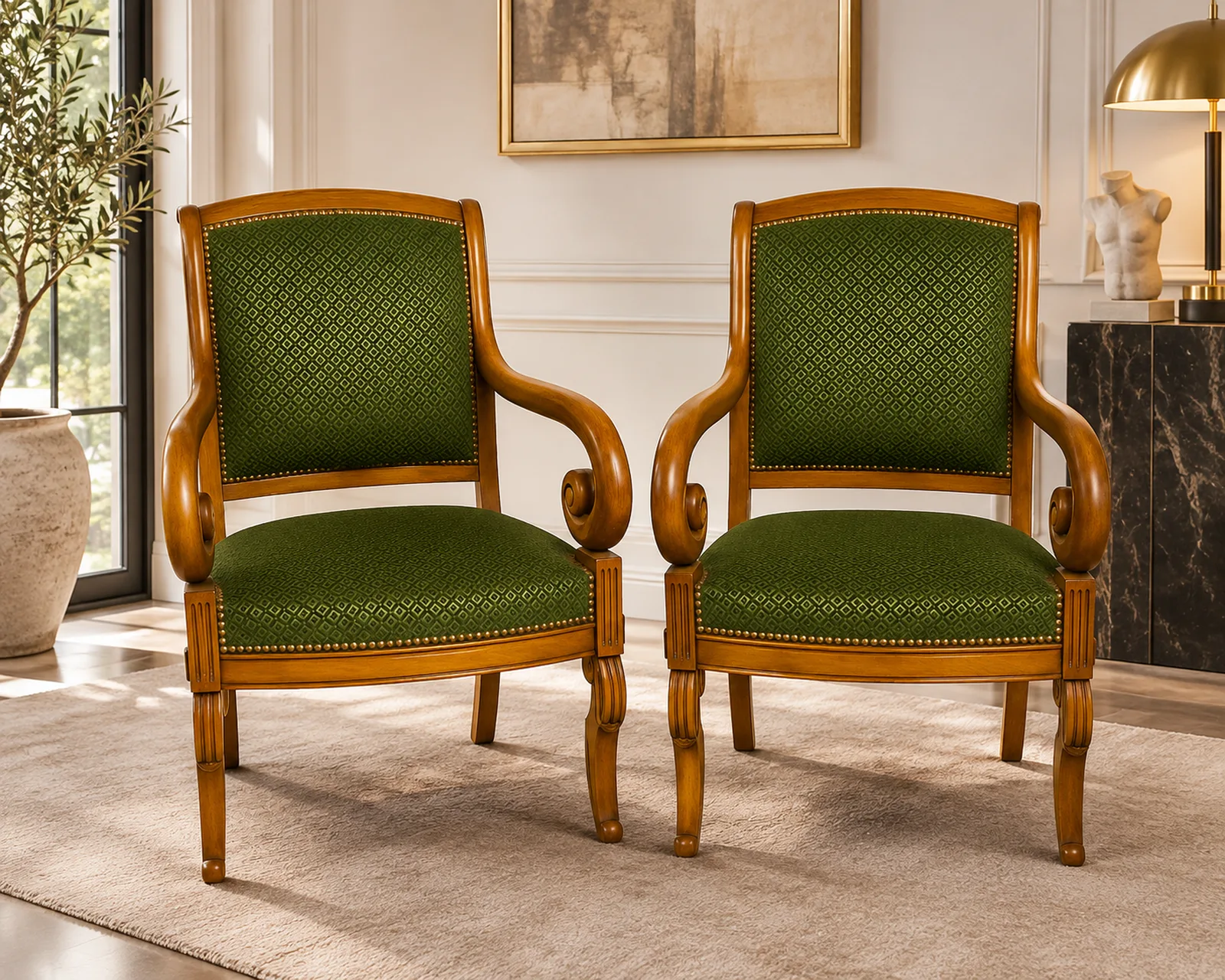
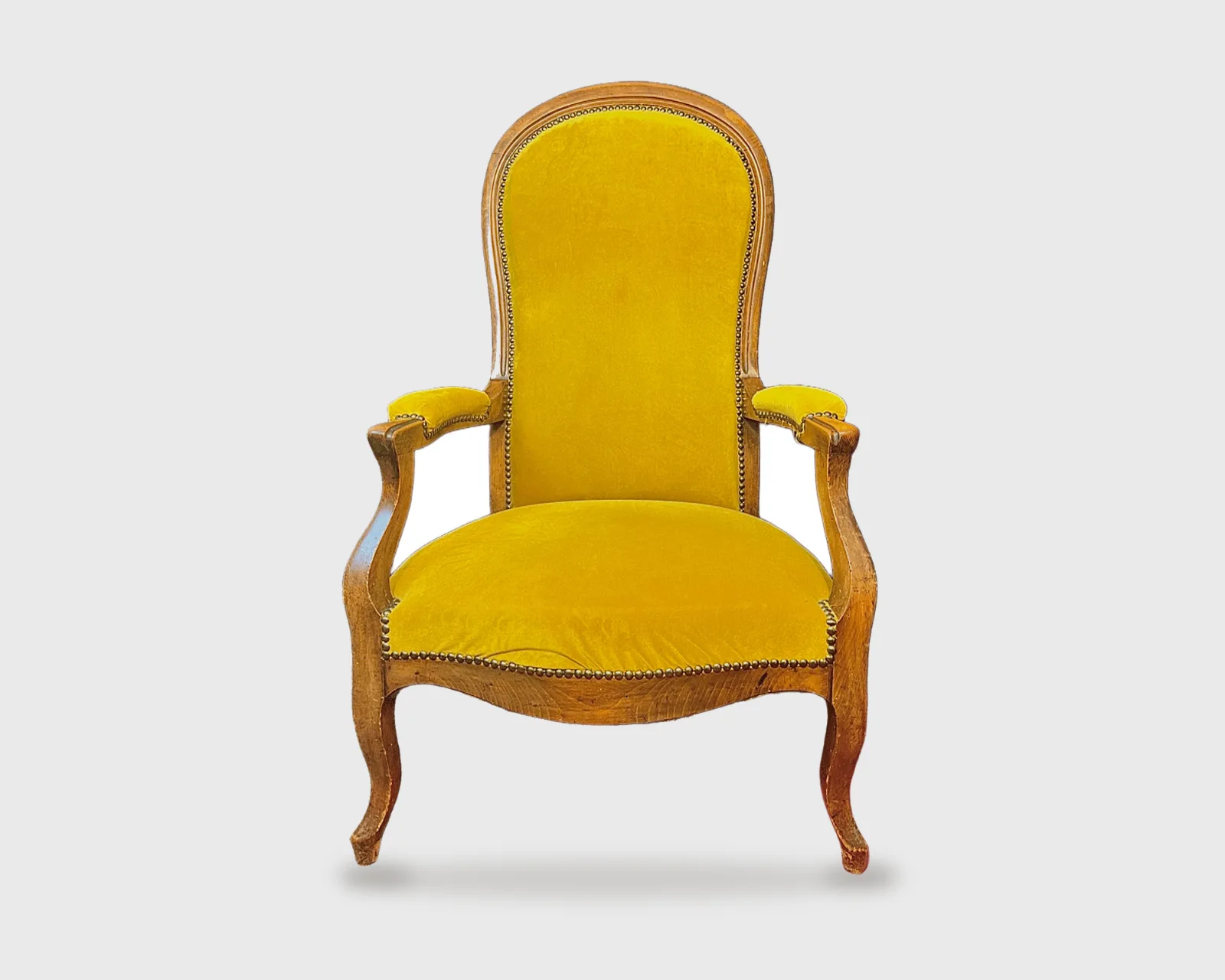
Our bombé marquetry commode with marble top is a 20th-century Louis XV-inspired piece: bombé front and sides, cabriole legs, two drawers decorated with floral marquetry, chased bronze mounts and a veined marble top. The pair of Empire-style armchairs likewise takes up an older style, in a late 20th-century make; the 19th-century Voltaire armchair has been fully restored. Browse all the gallery's furniture, and if you have a family piece whose history you would like to know, our expertise page explains how to show it to us.