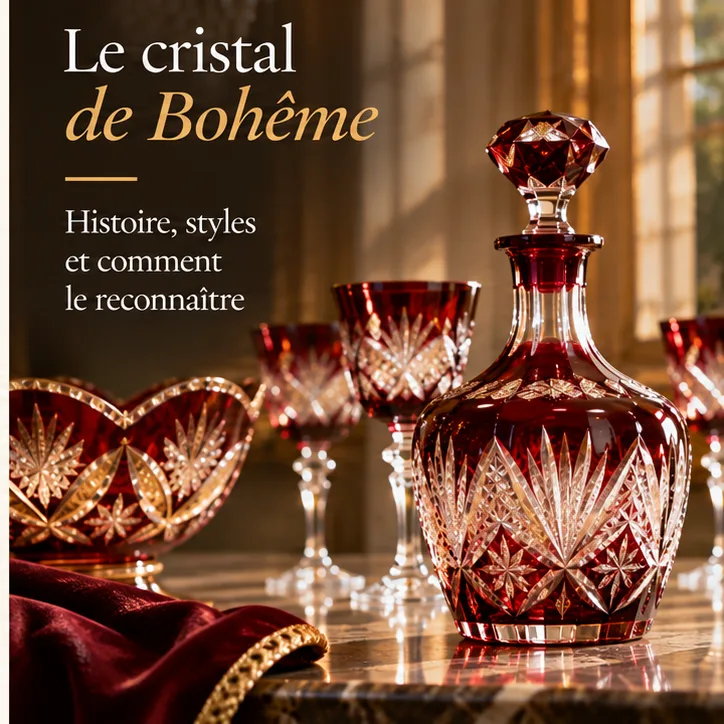
How can you recognise Bohemian crystal? The best clues are fine, precise wheel engraving, coloured or cased glass, where the colour layer is cut away to reveal clear glass beneath, and original marks or labels. The term refers to glass made in Bohemia, now in the Czech Republic: an origin and a tradition rather than a single composition, not to be confused with lead crystal. Here is its history, its main styles and some careful pointers for identifying it. See our glass and crystal pieces.
A Central European glass, distinct from lead crystal
Central European glass had long differed from Venetian “cristallo”. The Victoria and Albert Museum in London makes the point about a large enamelled beaker dated 1594, probably made in Bohemia: German “forest” glass was potash-based, whereas Venetian cristallo was soda-based.
Lead crystal, for its part, was developed in England: George Ravenscroft was granted a patent in 1673 and, in 1676, the use of a raven's head seal as a guarantee of quality. On this basis England overtook Venice and Bohemia as the centre of the glass industry in the 18th and 19th centuries. The earliest glass engraved in Prague therefore predates lead crystal, and keeping this chronology in mind avoids a good deal of confusion when looking at old glass.
Caspar Lehmann and the golden age of Baroque engraving
In the early 17th century Caspar Lehmann (Uelzen, 1563/1565 – Prague, 1622) was working in Prague as a glass and gem engraver to the imperial court: Jutta Kappel's monograph on him, cited by the Victoria and Albert Museum, calls him “kaiserliche Glas- und Edelsteinschneider”. The museum holds a wheel-engraved glass panel by him, made in Prague and dated 1619.
Bohemia went on to become known for the quality of its cutting and engraving. Between roughly 1685 and 1750, local production won an international reputation in the high Baroque style, and the Czech lands became the leading producer of decorative glassware.
The 19th century: Biedermeier, colour and cased glass
Engraving, which Vienna's Museum of Applied Arts (MAK) describes as the most difficult way of working glass, reached its peak in northern Bohemia during the Biedermeier period. In 2017 a MAK exhibition devoted to glass of the Empire and Biedermeier periods, covering the years 1780 to 1840, also highlighted two creations of the time:
- lithyalin by Friedrich Egermann (1777-1864), an opaque decorative glass imitating semi-precious stones, whose process he patented in 1828;
- “agate” glass from Count von Buquoy's glassworks at Georgenthal (Petříkov).
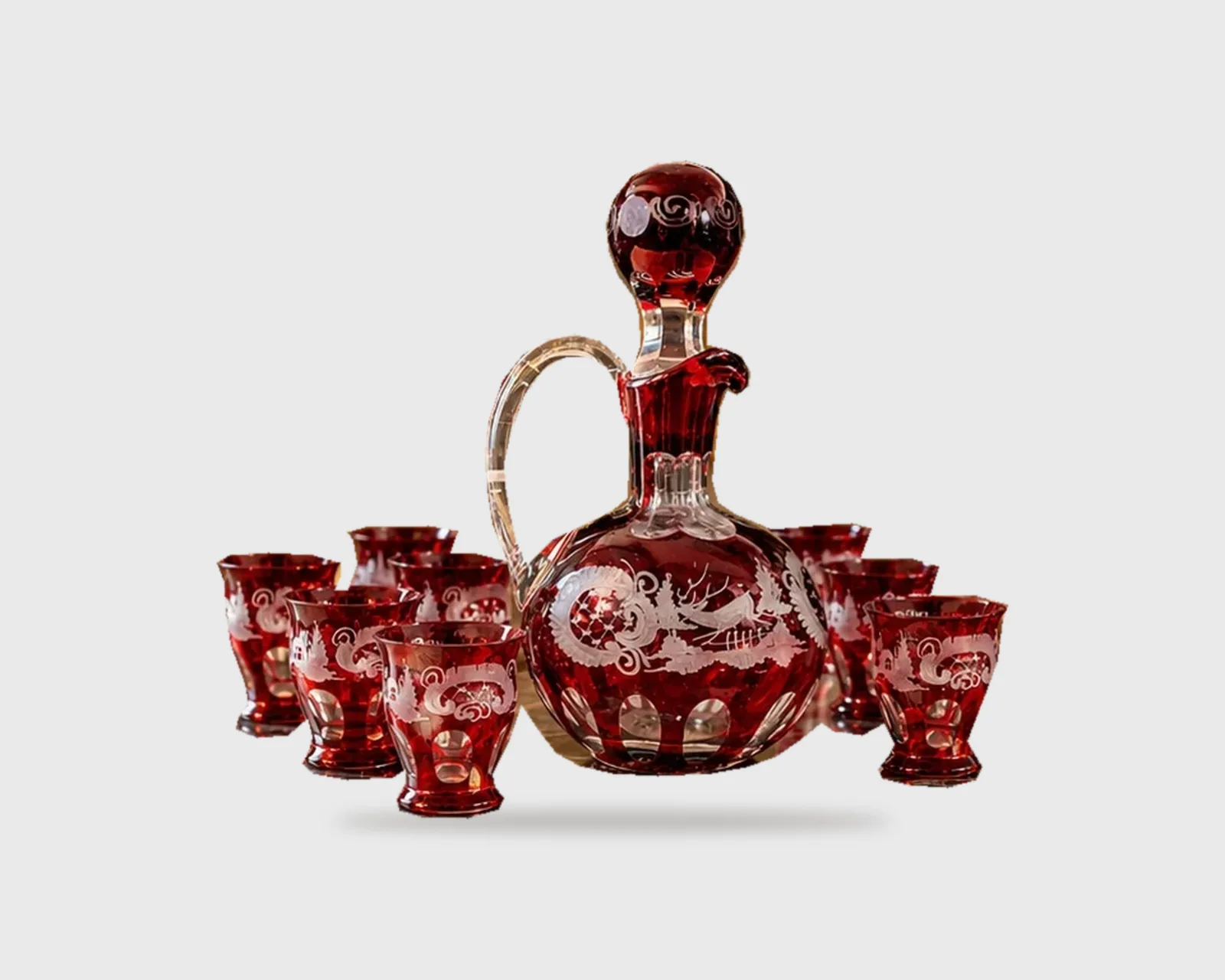
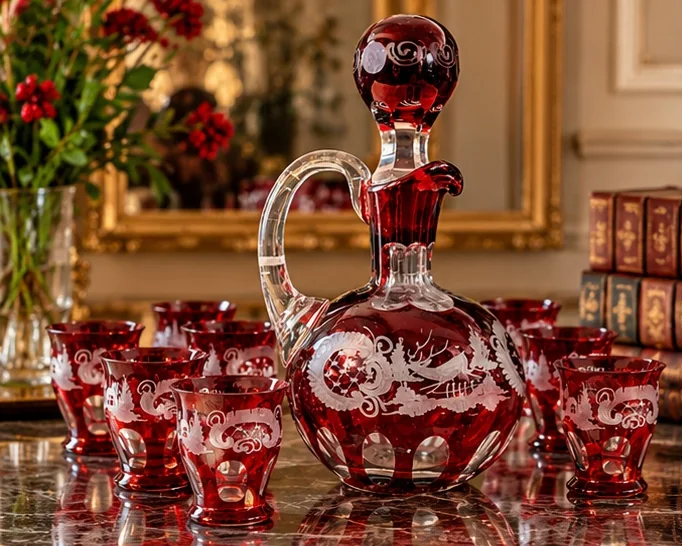
Cased or flashed glass combines a layer of coloured glass with colourless glass: when it is cut or engraved, the decoration goes through the coloured layer to reveal the clear glass. The Victoria and Albert Museum holds an example: a Bohemian beaker of about 1840, in flashed, cut and engraved glass, whose sprays of flowers and named views (“Prebischthor”, “Winterberg”, “Bastei”) are wheel-engraved through the ruby flashing.
In the second half of the 19th century, Bohemia looked to the export trade and mass-produced coloured glass, for example pairs of vases in a single colour of opaque glass or in two-colour cased glass.
Moser, Crystalex and the Bohemia Crystal brand
In 1857 the engraver and entrepreneur Ludwig Moser opened a workshop and shop in Karlovy Vary (Carlsbad), the Bohemian spa town. His name remains one of the best known in Czech glass.
In 20th-century Czechoslovakia, glassmaking remained at a high level, even under the communist regime, which regarded it as ideologically harmless; Czech glass was shown, notably, at the world's fairs in Brussels (1958) and Montreal (1967). In 1948 the national enterprise Borocrystal brought together 55 small glassworks and workshops around Nový Bor; the group became Borské sklo in 1953 and took the name Crystalex in 1974. Privatised after 1989, the company went bankrupt in the wake of the 2008 financial crisis; it owns the Bohemia Crystal trademark.
Two things should therefore be kept apart: “Bohemian crystal”, a general term referring to a region and a tradition, and “Bohemia Crystal”, the registered trademark of one specific company.
Bohemian glass or lead crystal: telling them apart
In the European Union, Directive 69/493/EEC of 1969 governs the names used for crystal glass: only glass containing at least 24% lead oxide may be sold as “lead crystal”.
The word “Bohemian” therefore points to an origin and a tradition, not to a composition. A piece from Bohemia may or may not be labelled “lead crystal”; only the original label, or an analysis, tells you the composition of a given piece.
How to recognise it: a few pointers, no certainties
No simple test can prove that a glass is Bohemian, or date it. A few observations nevertheless help you look at it more closely:
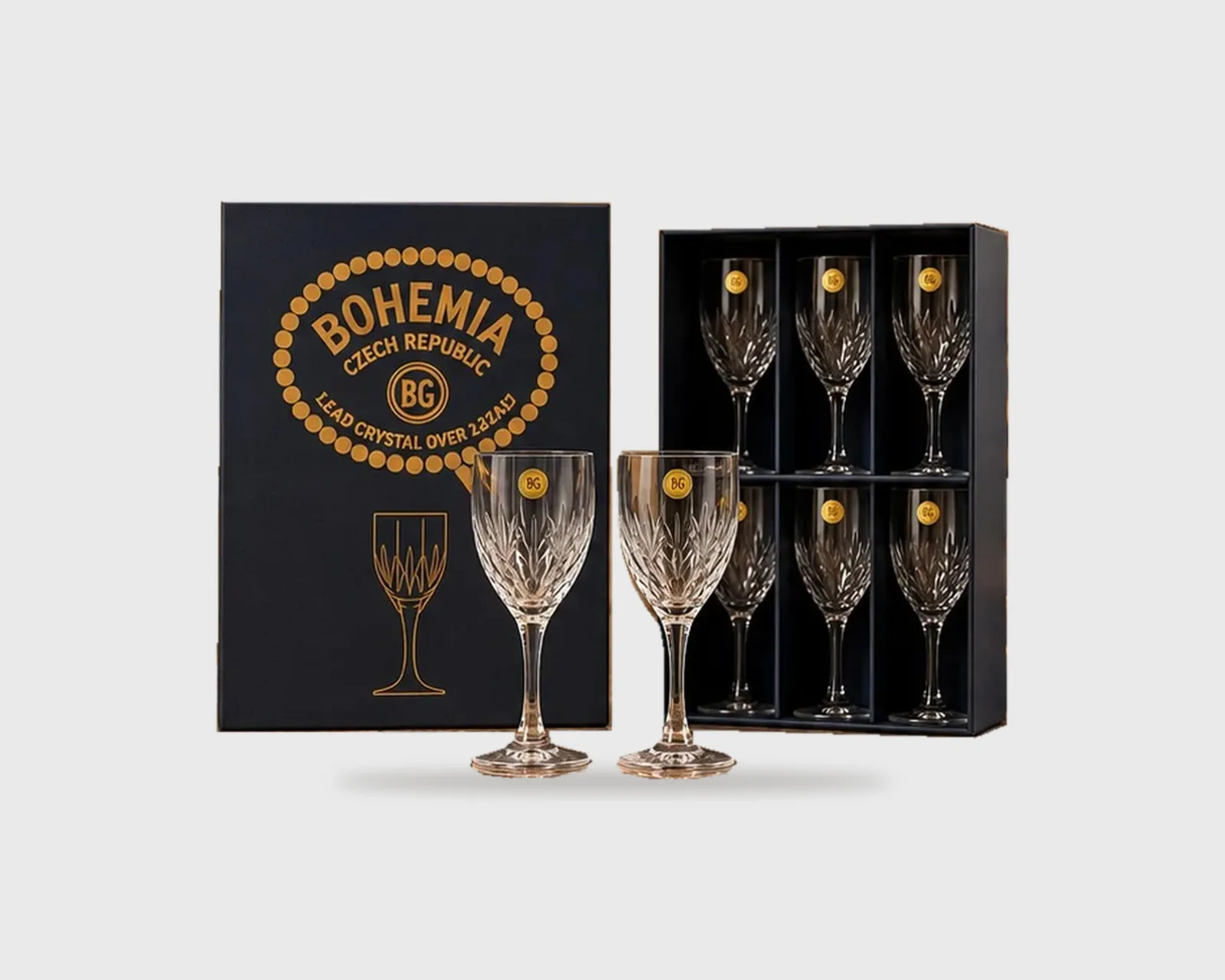
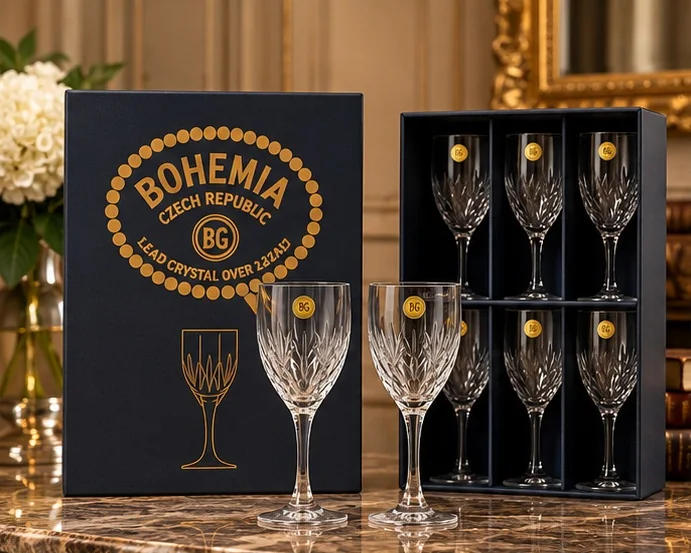
- Marks and labels. A sticker, an original box or a “Bohemia” label indicate a brand or a stated origin; on their own, they say nothing about the age of the piece.
- Cased glass. On cased glass the colour is a true layer of glass: along the edges of cut or engraved motifs, you can see its thickness above the colourless glass.
- Weight and sound. Lead crystal is denser than ordinary soda-lime glass (about 3.1 against 2.4 g/cm³) and rings when lightly tapped. These clues point to the presence of lead, not to a Bohemian origin.
- Decoration. Stags, castles, forests, views of sights and spa towns are common motifs on Bohemian glass, but on their own they are not enough to date a piece or guarantee its origin.
- Quality of workmanship. The subtlety of an engraving's modelling or the crispness of a cut tells you about the care taken over the piece more than about its origin.
For an attribution or a date, nothing replaces a specialist examining the piece in person.
Frequently asked questions
Does Bohemian crystal contain lead? Not necessarily: the term refers to an origin and a tradition, not to a composition. The earliest glass engraved in Prague predates lead crystal, which was developed in England in the 1670s. For a given piece, only the original label or an analysis will tell you; in Europe, the name “lead crystal” requires at least 24% lead oxide.
What is the difference between “Bohemian crystal” and “Bohemia Crystal”? “Bohemian crystal” is a general term tied to a region and a glassmaking tradition. “Bohemia Crystal” is a registered trademark owned by the Crystalex company of Nový Bor.
What is red cased Bohemian glass? It is colourless glass combined with a layer of red glass, which cutting or engraving goes through to reveal clear motifs. The Victoria and Albert Museum holds a Bohemian example of about 1840, wheel-engraved through the ruby flashing.
Who was Caspar Lehmann? A glass and gem engraver to the imperial court, born in Uelzen around 1563-1565 and died in Prague in 1622, he worked in Prague in the early 17th century. The Victoria and Albert Museum holds a wheel-engraved glass panel by him dated 1619.
How can I tell whether my Bohemian glass is old? There is no simple test: labels, decoration, weight or sound are not enough. Examination by a specialist, weighing technique, style, wear and provenance together, remains the surest route.
Bohemian crystal at the gallery
Two sets in the gallery illustrate this tradition: a liqueur service in Bohemian ruby crystal cased over clear crystal, a spherical decanter and eight glasses engraved with a stag, landscapes and scrolling foliage, and a set of 12 cut-crystal stemmed glasses by Bohemia, in their original boxes with authenticity stickers. More pieces await in our Glass and crystal collection. Do you own a piece of Bohemian glass and would like to know more? Our appraisal service is here to help.