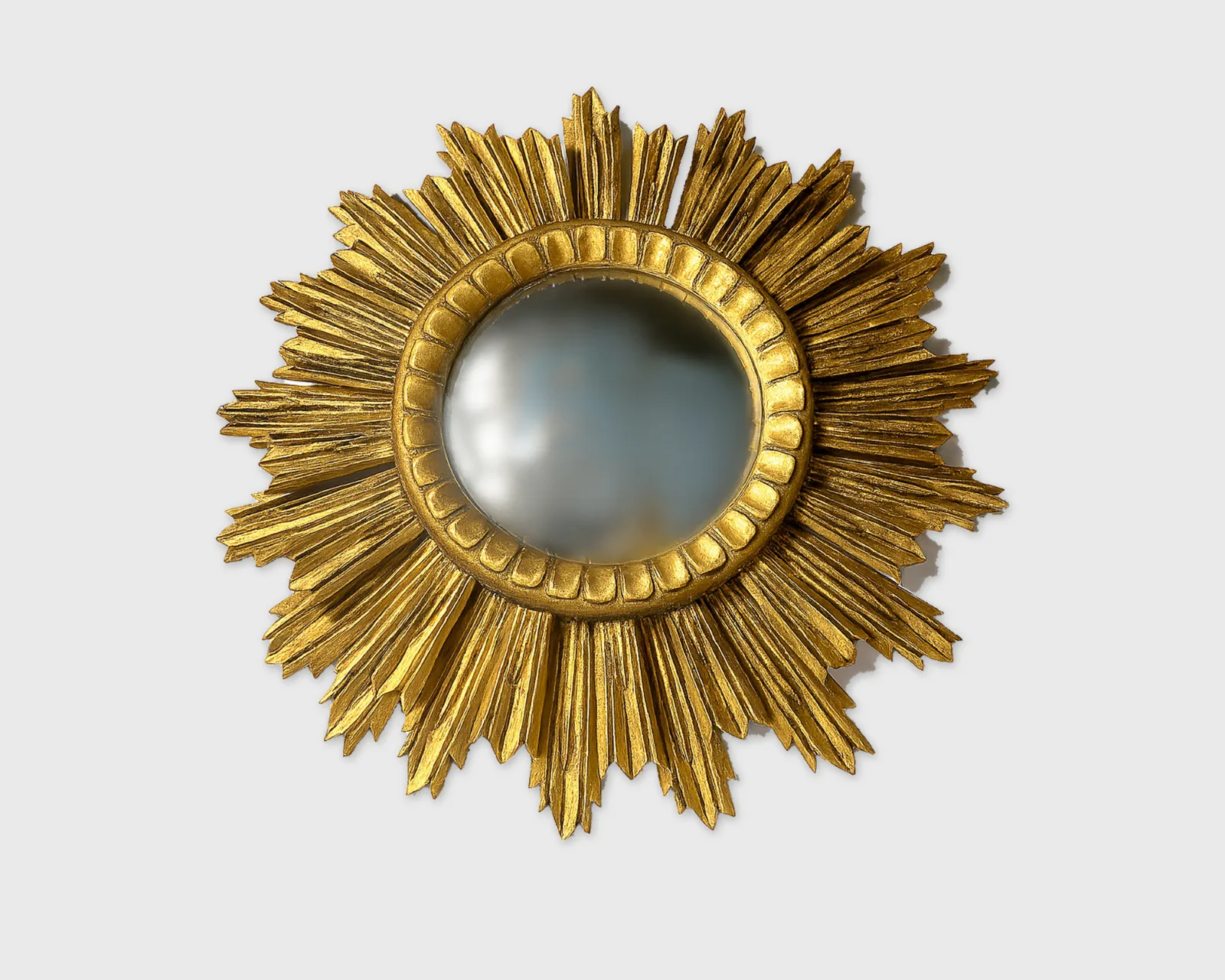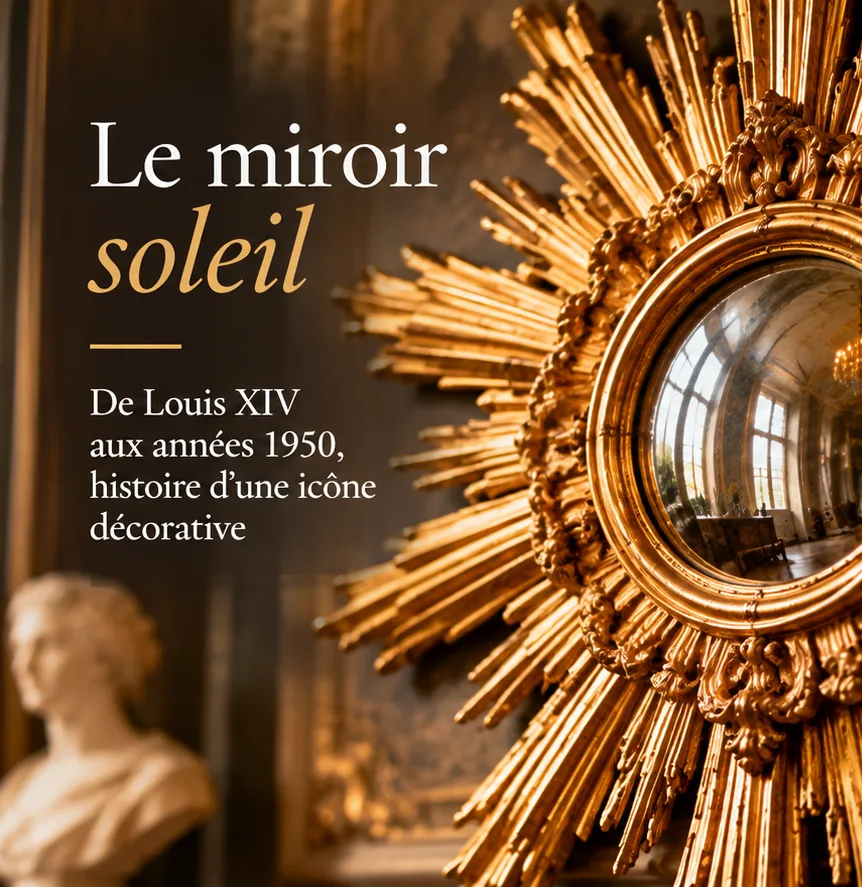
The sunburst mirror is a round, often convex mirror surrounded by a crown of rays in giltwood or metal. It brings together two much older traditions: the image of the sun, which Louis XIV placed at the heart of his royal image in the 17th century, and the convex mirror, already painted by Jan van Eyck in 1434. None of the sources consulted, however, traces the sunburst mirror itself back to the court of the Sun King: the link between them is a reference rather than a documented line of descent.
The sun, emblem of a king
The nickname 'Sun King' stems from a political choice. At the start of his personal rule, Louis XIV adopted the sun and Apollo, god of the sun, as images of his power. The Louvre notes that the decoration of the Galerie d'Apollon, commissioned from 1662 after the fire in the Petite Galerie (6 February 1661) and painted under Charles Le Brun, is devoted to Apollo, whom Louis XIV had just chosen as his emblematic figure.
At Versailles the motif is everywhere. In the Hall of Mirrors, built by Jules Hardouin-Mansart between 1678 and 1684, the pilaster capitals combine a fleur-de-lis crowned by the royal sun between two cockerels. The same gallery lines up 357 mirrors across 17 arcades facing the windows: for the Palace of Versailles, they demonstrate that the new French glass manufactory could wrest the mirror monopoly from Venice.
Sun and mirror thus sit side by side in the royal décor, but not as a single object. It is this association, which became a cultural reflex, that radiating mirrors seem to recall today.
The convex mirror, an ancient 'eye'
The sunburst mirror's other ancestor is the convex mirror. Its most famous example is painted in The Arnolfini Portrait by Jan van Eyck, in the National Gallery, London. At the centre of the picture, a convex mirror reflects the room in compressed form and reveals two men at the door; directly above it, the inscription 'Johannes de Eyck fuit hic. 1434' ('Jan van Eyck was here. 1434') dates the work. A detail that anticipates our sunburst mirrors: its frame is punctuated by ten small roundels radiating around the glass, each showing a scene from the Passion of Christ.
In French this type of mirror goes by several names: miroir de sorcière, œil de sorcière ('witch's eye') or miroir de banquier ('banker's mirror'). According to a frequently repeated tradition, Flemish bankers, merchants and jewellers hung it behind their counters to take in the whole shop at a glance. Folk belief also credited it with turning the evil eye back on whoever cast it: this is folklore rather than established history, but the nickname has stuck.
From gilded frame to radiating mirror
The convex mirror did not vanish after the Renaissance. Around 1800 it reappears in England in large decorative mirrors: Princeton University Art Museum, for instance, holds an English convex mirror of that period in carved, gessoed and gilded wood, 135 cm high with a glass 53 cm across; its record lists an eagle, dolphins and candlesticks among its motifs. Giltwood and convex glass were already a familiar pairing.
The sunburst mirror proper adds a crown of rays to the convex glass, either straight or, as on some giltwood models, of alternating lengths. In the 20th century it became associated in particular with a French designer, Line Vautrin.
Line Vautrin and the 'miroirs sorcières'
Among the figures associated with these mirrors, Line Vautrin (1913–1997) holds a special place. She had a stand at the 1937 Paris International Exhibition and opened her first shop the following year, in the rue de Berri. Known first for her jewellery, buttons and gilt bronze boxes, she developed a material she named talosel, based on cellulose acetate, which she shaped, cut or heated. She used it in particular to decorate the surrounds of her mirrors.
Her convex 'witch' mirrors, with their finely chased frames, are now among her best-known creations; she also made so-called 'sun' mirrors. In 1999, two years after her death, the Musée des Arts Décoratifs in Paris showed her work in the exhibition 'Secret de bijoux, Line Vautrin et onze créateurs d'aujourd'hui', and brooches by her are in its collections. She had received the Prix national des Métiers d'Art in 1992. Line Vautrin's mirrors are designer pieces: not every sunburst mirror is by her hand, and only close study of a piece can tell.
How to look at a sunburst mirror
Whether you are buying, inheriting or simply looking after a sunburst mirror, a few points deserve attention.
- The gilding. On wood, traditional gold-leaf gilding sits on around ten layers of ground made from rabbit-skin glue and calcium carbonate, then on a clay 'bole' that receives the leaf, which is finally burnished with an agate stone. This layered build-up explains the typical losses: chips in the ground, wear on the edges, touch-ups in gold paint. Light wear is part of the object's life; repairs should be left to a gilder.
- The rays. These are the most exposed parts. Check that no ray is broken, reglued or replaced, and that the crown is firmly attached to the central frame.
- The glass. Convex glass cannot be replaced like a flat pane: check that it is intact, with no chips or cracks. Look at the reflective backing too: dark spots or a cloudy or glittering surface point to deterioration. Silvering, developed in the mid-19th century, only fully replaced the old tin-mercury amalgam in the 20th century, so a mid-20th-century mirror is in principle silvered.
- Hanging. A giltwood mirror is light but fragile: a sound fixing and a suitable hook prevent a fall, which breaks the rays first.
The sunburst mirror in today's interiors
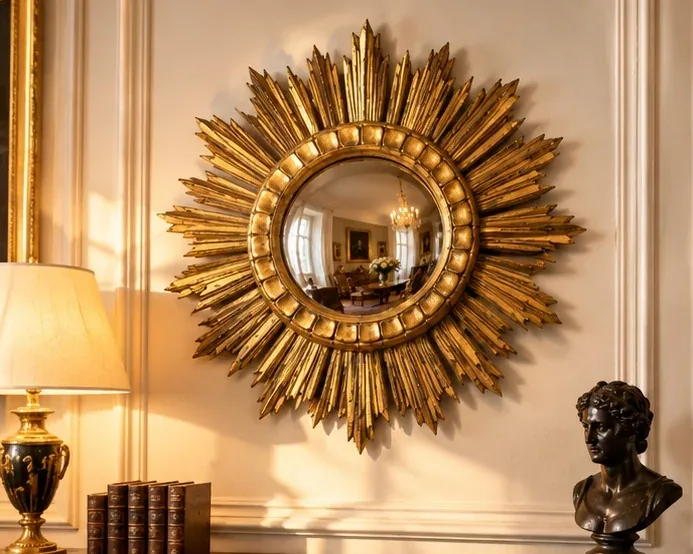
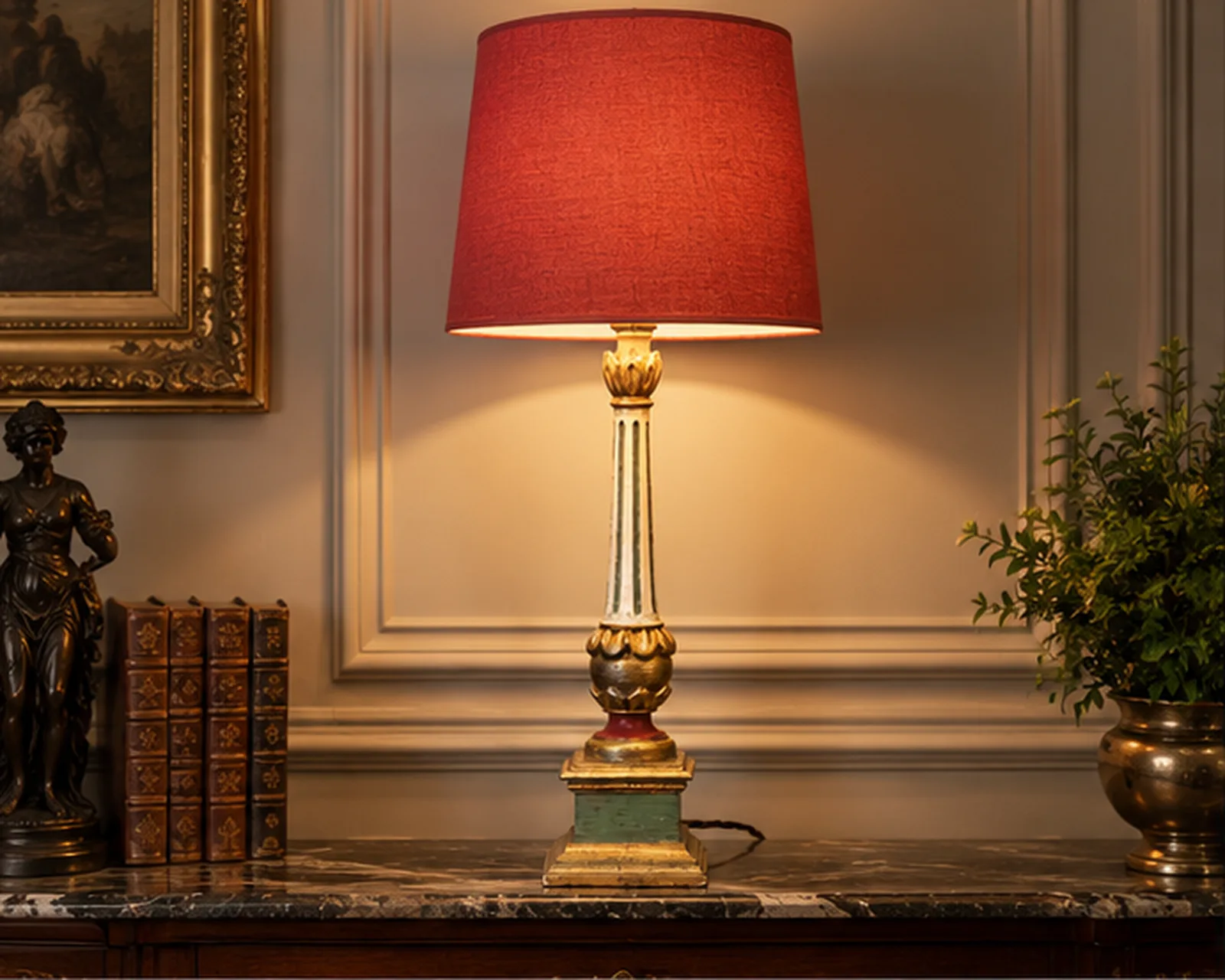
Its small convex glass is not for checking your reflection: it gathers the room into a miniature image and catches the light. It is often hung opposite a window, in a hallway, above a console table or a fireplace. Its gilded crown makes it a focal point on a plain wall; on its own it is enough, and it sits as happily with antique furniture as with a contemporary scheme. In a grouping it naturally converses with other giltwood pieces, such as a lamp or frames.
Frequently asked questions
Did sunburst mirrors exist under Louis XIV? There is no evidence that they did. Louis XIV made the sun and Apollo the emblems of his reign, and Versailles is full of royal suns and mirrors, but none of the sources consulted records a sunburst mirror with convex glass at his court. The link with the Sun King is a reference, not a documented origin.
Why is it called a 'witch's eye'? It is one of the French names for the convex mirror, alongside 'witch's mirror' and 'banker's mirror'. Folk belief credited it with sending the evil eye back; its practical use, attributed to merchants, was to watch over a whole room at a glance.
What is talosel? It is a material created by Line Vautrin from cellulose acetate, which she shaped, cut or heated. She used it notably to decorate the surrounds of her mirrors.
How should a giltwood sunburst mirror be cared for? A light dusting with a soft brush is enough. Avoid household products and rubbing the gilding, which is a very thin layer laid over a fragile ground. For a chip, a loose ray or gilding that needs attention, consult a gilder or a conservator.
In conclusion
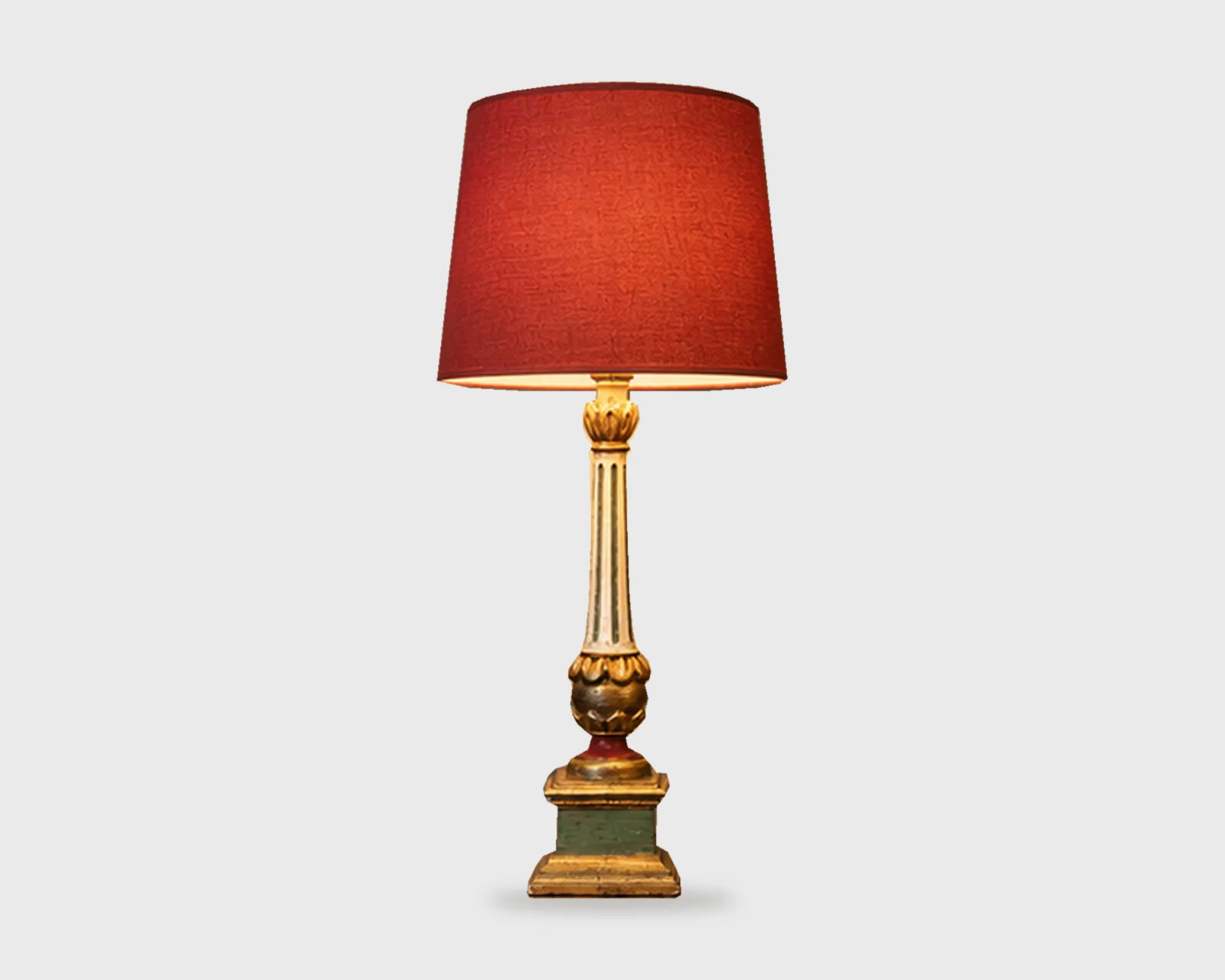
From the royal sun of Versailles to Van Eyck's convex mirror, the sunburst mirror distils several centuries of imagery into a single decorative object. The gallery currently offers a giltwood sunburst mirror with convex glass, with rays of alternating lengths, which pairs well with a Florentine lamp in carved, gilded and painted wood, also from the mid-20th century. More pieces await you in our decorative arts. Do you own a sunburst mirror and would like to know more about it? Show it to us through our appraisal page.