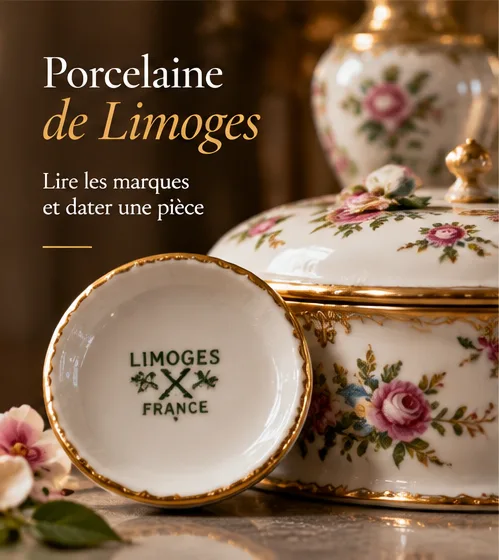
To date a piece of Limoges porcelain, begin by turning it over and reading the marks. Most often you will find a green mark under the glaze, naming the factory that made the white porcelain, and sometimes a second mark over the glaze, left by the workshop that decorated it. These marks place a piece within a period rather than in a specific year: they should always be read together with its shape, its decoration and the history of the firm concerned.
Why Limoges: the kaolin of Saint-Yrieix
Hard-paste porcelain requires a very white clay called kaolin. In France, the first deposit was discovered around 1768 at Saint-Yrieix-la-Perche, south-west of Limoges. The specification for the « Porcelaine de Limoges » geographical indication credits the discovery to the surgeon Jean-Baptiste Darnet; some sources place it as early as 1767. Turgot, then intendant of the Limousin, quickly saw its economic potential, and the first piece made from Limousin clay was produced in September 1771. The Limoges manufactory received the title of royal manufactory in 1784.
The nineteenth century turned Limoges into a capital of porcelain. Official records list 5 factories in 1806, 16 in 1827 and 24 in 1839. By the early twentieth century the industry employed just over 11,000 workers across some thirty production sites, plus a number of independent decorating workshops. « Limoges » therefore refers to a production centre, not a single factory. That is the first thing to bear in mind when looking at a mark: the name of the city alone does not tell you who made the piece.
The great houses
Certain names appear again and again on the undersides of pieces. A few verified landmarks:
- Haviland: in 1842, the American David Haviland founded Haviland & Co. to produce designs for the American market. In 1860 his factory employed 200 workers, 128 of them decorators; by 1900, 2,000 workers, 300 of them decorators. A United States consulate opened in Limoges in 1866 to facilitate porcelain exports.
- Bernardaud: the house was established in 1863.
In 2017 Haviland, Bernardaud and Raynaud were among the founding members of the association behind the geographical indication, alongside many other factories and decorating workshops. The 128 decorators at Haviland in 1860 point to something essential for anyone trying to date a piece: in Limoges, making and decorating are two separate trades, and the marks reflect this.
Camille Tharaud and colour within the glaze
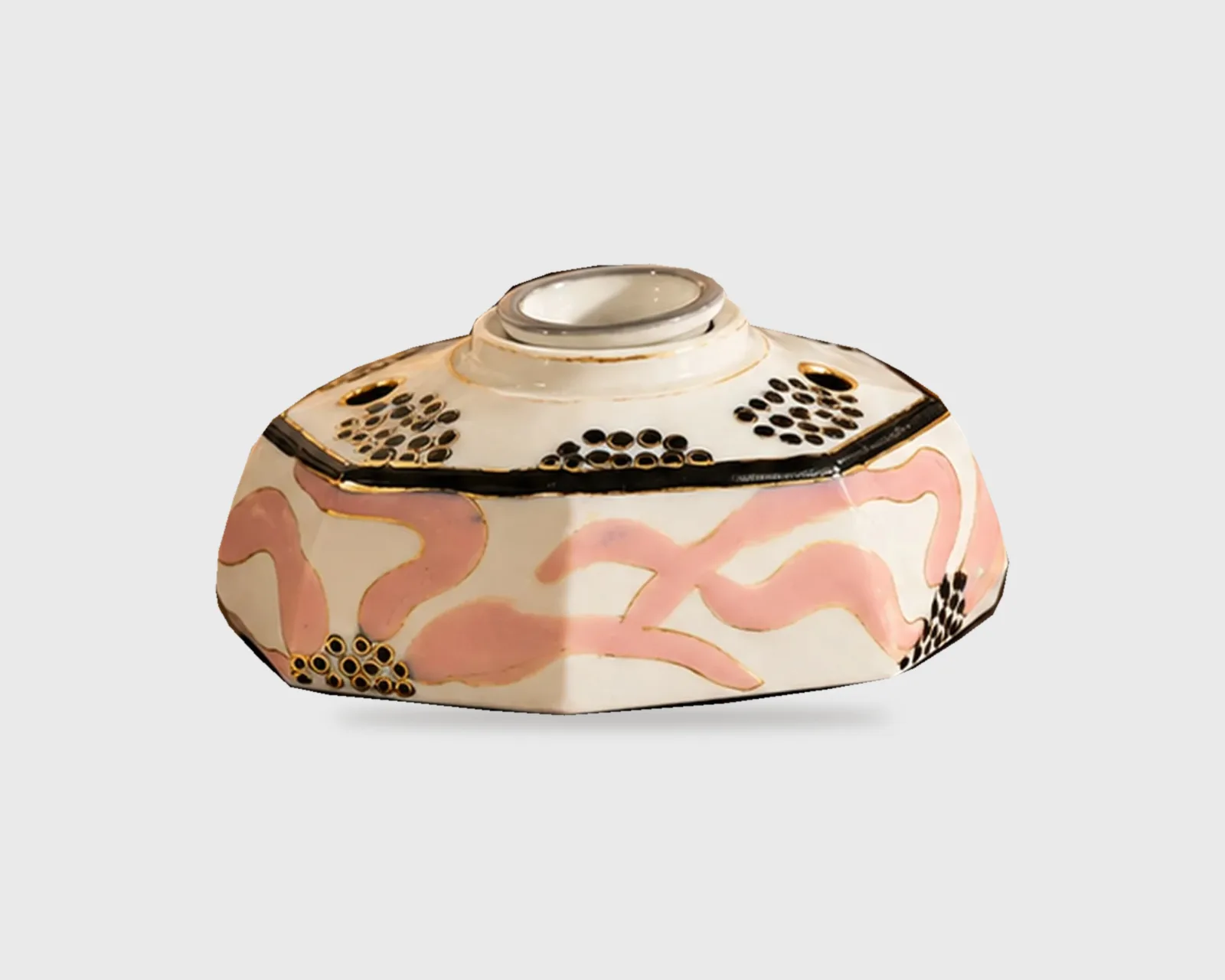
Camille Tharaud was born in Limoges on 20 April 1878 and died on 8 September 1956. On 29 January 1920 he bought a former factory, founded in 1854 and abandoned for thirty-five years. His contribution lies in his decoration in fused coloured glaze: he succeeded in colouring the glaze throughout its thickness rather than painting colour on the surface. The geographical indication specification indeed lists coloured glaze among the so-called high-fired colours, fired at the same temperature as the porcelain itself.
Tharaud took part in the 1925 International Exhibition of Modern Decorative and Industrial Arts, and the Musée national Adrien-Dubouché in Limoges holds several of his vases. His work shows that Limoges porcelain is not limited to dinner services: it also includes decorative and desk objects.
Reading the marks: the factory and the decorator
Several marks may sit side by side on the underside of a Limoges piece. Each corresponds to a different stage.
- The factory mark, in green, under the glaze. It is applied to the « blanc », the trade term for glazed but undecorated porcelain, and identifies the house that made the piece. Public collection catalogues describe it as a green underglaze mark on white ware.
- The decorator's mark, over the glaze. It is applied on top of the already fired glaze, like so-called low-fired decoration, and names the workshop or house that decorated the piece. It is often in a different colour: at GDA (Gérard, Dufraisseix and Abbot), the decorating mark appears always to have been red.
- Place and country names. « Limoges », « France » or « Limoges France » form part of one mark or the other.
A single piece may therefore carry the name of one maker and that of a different decorator. Conversely, a piece left undecorated may bear only the factory mark. Before any research, note each mark separately, with its colour and its position, under or over the glaze.
Dating by the marks
- The word « France ». Under the American McKinley tariff law, goods imported into the United States had to show their country of origin. Reference works conclude that a Limoges mark including the word « France » dates from after 1891. The rule only works one way: it concerned American imports, and the absence of the word is not enough to prove that a piece is older.
- Periods of use. Each house changed its mark as partnerships formed and firms changed hands. When Abbot, who had handled the company's import business in New York, joined Gérard and Dufraisseix in 1900, the firm's mark changed to include his initials; the green « GDA France » mark is dated to around 1900 to 1941. A mark therefore places a piece within a range that may span several decades.
- Marks passed on. GDA went on using, until around 1941, a decorating mark inherited from the firm that preceded it. A mark can thus outlive the company that created it, or pass from one house to another.
- Today's stamps. For current production covered by the geographical indication, the « Porcelaine de Limoges » or « Limoges » stamp must be accompanied by the maker's name, its marks, the client's brand or a sign that links the piece to the maker. It must be indelible, fixed by firing, sintering, engraving, sandblasting or marking in the body; removable labels are forbidden.
The « Porcelaine de Limoges » geographical indication
The Limoges name has long been defended. As early as 1910, a ruling of the Bourges commercial court prohibited the use of « Limoges » as a mark on porcelain made outside Limoges. In 1929, 33 factories created the collective mark « Limoges Unique ». In 1983, France's Court of Cassation ruled that a buyer of decorated porcelain stamped « Limoges France » was entitled to believe that it had been both made and decorated in Limoges.
The « Porcelaine de Limoges » geographical indication was approved by INPI, the French intellectual property office, on 1 December 2017. Its area is the Haute-Vienne département, and every stage, both making and decorating, must take place there. Two types of product are covered: undecorated porcelain made within the area and sold as a finished product, and porcelain both made and decorated within the area. A piece made in Haute-Vienne but decorated elsewhere cannot receive the stamp, nor can a piece made elsewhere and decorated in Limoges. In May 2026, Porcelaine de Limoges became the first craft and industrial product to receive geographical indication protection throughout the European Union, under the EU's new scheme for such products.
For an antique piece, these recent rules are not retroactive: they clarify what a mark means today, but they do not date an object from the nineteenth or early twentieth century.
Points to watch
- Two marks, two stages. The green mark tells you about the making of the white ware, the decorator's mark about the workshop that ornamented it. They do not describe the same stage in the life of the piece.
- One mark, one period. Most marks were used for years, sometimes decades. They give a range, not a precise date.
- A coveted name. Before the First World War, an American earthenware factory in Ohio was already marking its products « Limoges China ». The word « Limoges » alone is therefore no guarantee of an antique piece's origin.
- Cross-check the evidence. Shape, decoration, gilding and technique count as much as the mark. In the nineteenth century, for instance, chromolithography, a form of transfer decoration, made it possible to multiply patterns.
- Use the reference works. Mary Frank Gaston's The Collector's Encyclopedia of Limoges Porcelain (Collector Books, 1996) records a great many marks. In Limoges itself, the Musée national Adrien-Dubouché holds the richest public collection of Limoges porcelain.
Frequently asked questions
What does the green mark under a Limoges plate mean? It is usually the factory mark: applied under the glaze, on the white porcelain, it identifies the house that made the piece. On its own, it says nothing about the workshop that may later have decorated the piece.
Is a piece marked « Limoges France » necessarily old? No. According to reference works, the word « France » indicates a piece made after 1891, but the wording remained in use throughout the twentieth century and is still used today. Only by cross-checking with the maker's specific mark, the decoration and the shape can the period be narrowed down.
Can an unmarked piece of porcelain come from Limoges? Yes. The current specification itself states that stamping is optional: factories may leave some of their production unstamped for clients who prefer to highlight their own brand. The absence of a mark does not rule out a Limousin origin, but it makes identification harder and calls for an examination of the piece itself.
Since when has « Porcelaine de Limoges » been protected? The name has been defended in the courts since at least 1910. The geographical indication was approved by INPI on 1 December 2017, then registered as a European Union geographical indication in May 2026. It requires both making and decorating to take place in Haute-Vienne.
What sets Camille Tharaud's porcelain apart? His decoration in fused coloured glaze: he managed to colour the glaze throughout its thickness rather than painting colour on the surface. Working in his own factory from 1920, he exhibited at the 1925 International Exhibition of Decorative Arts.
At the gallery
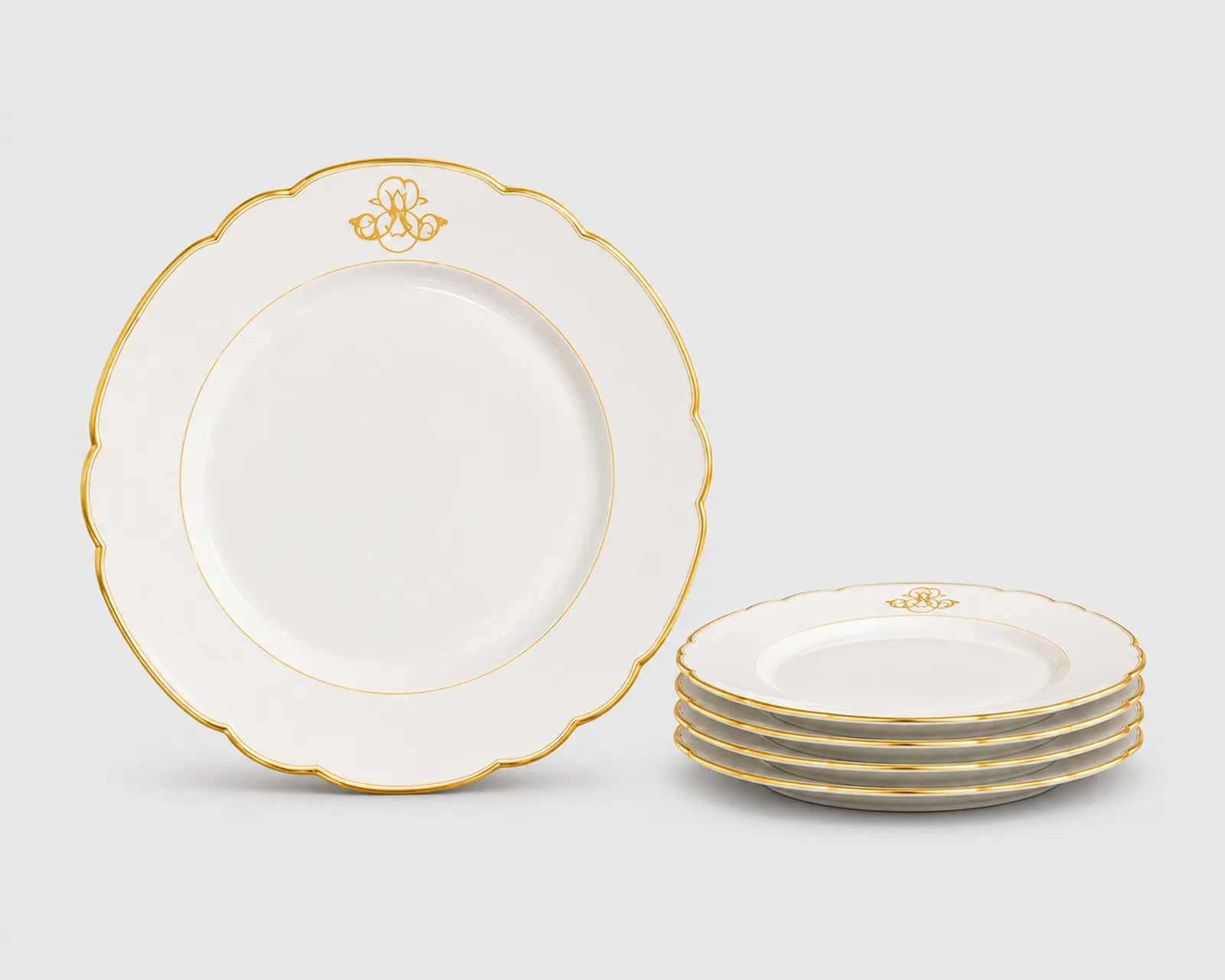
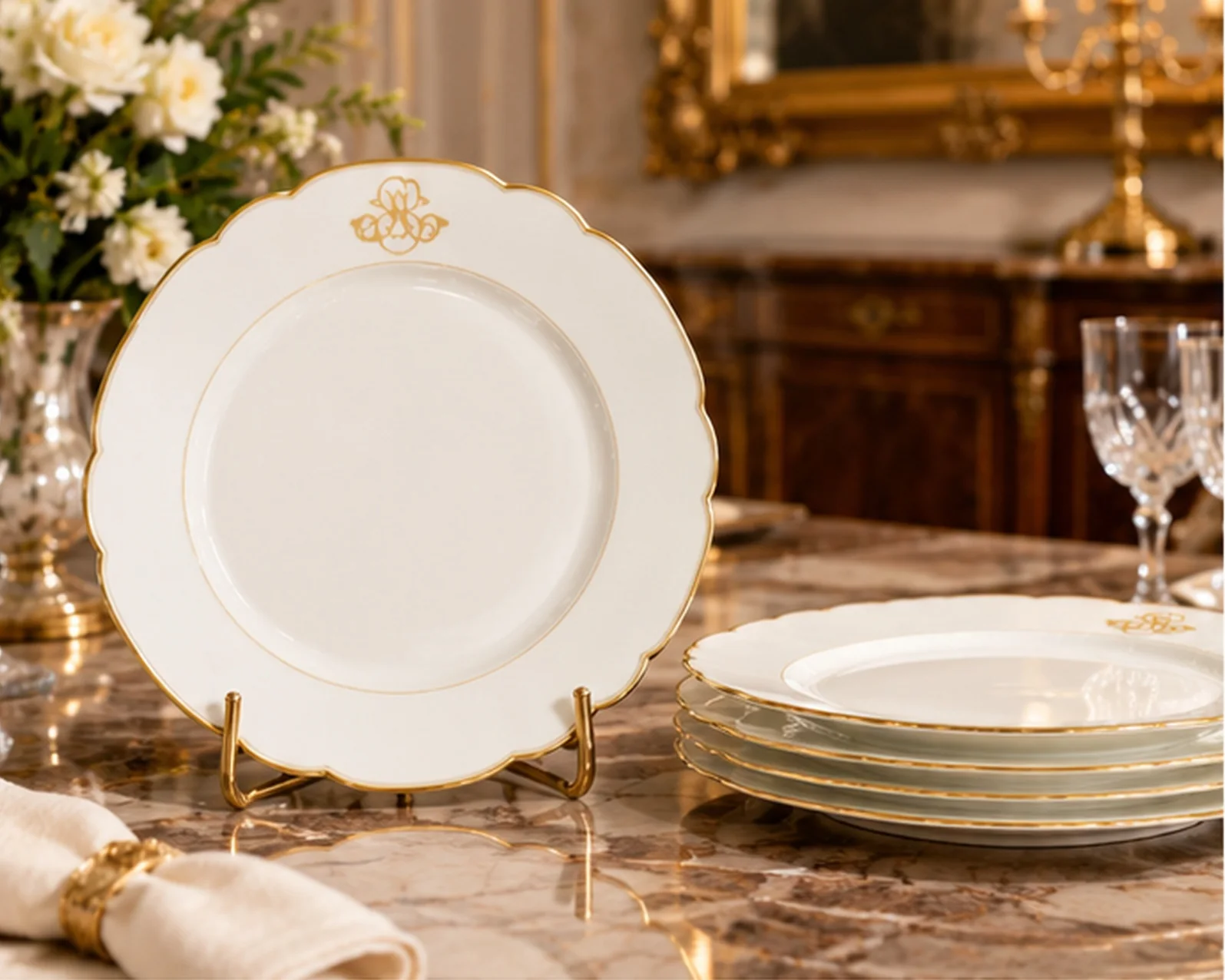
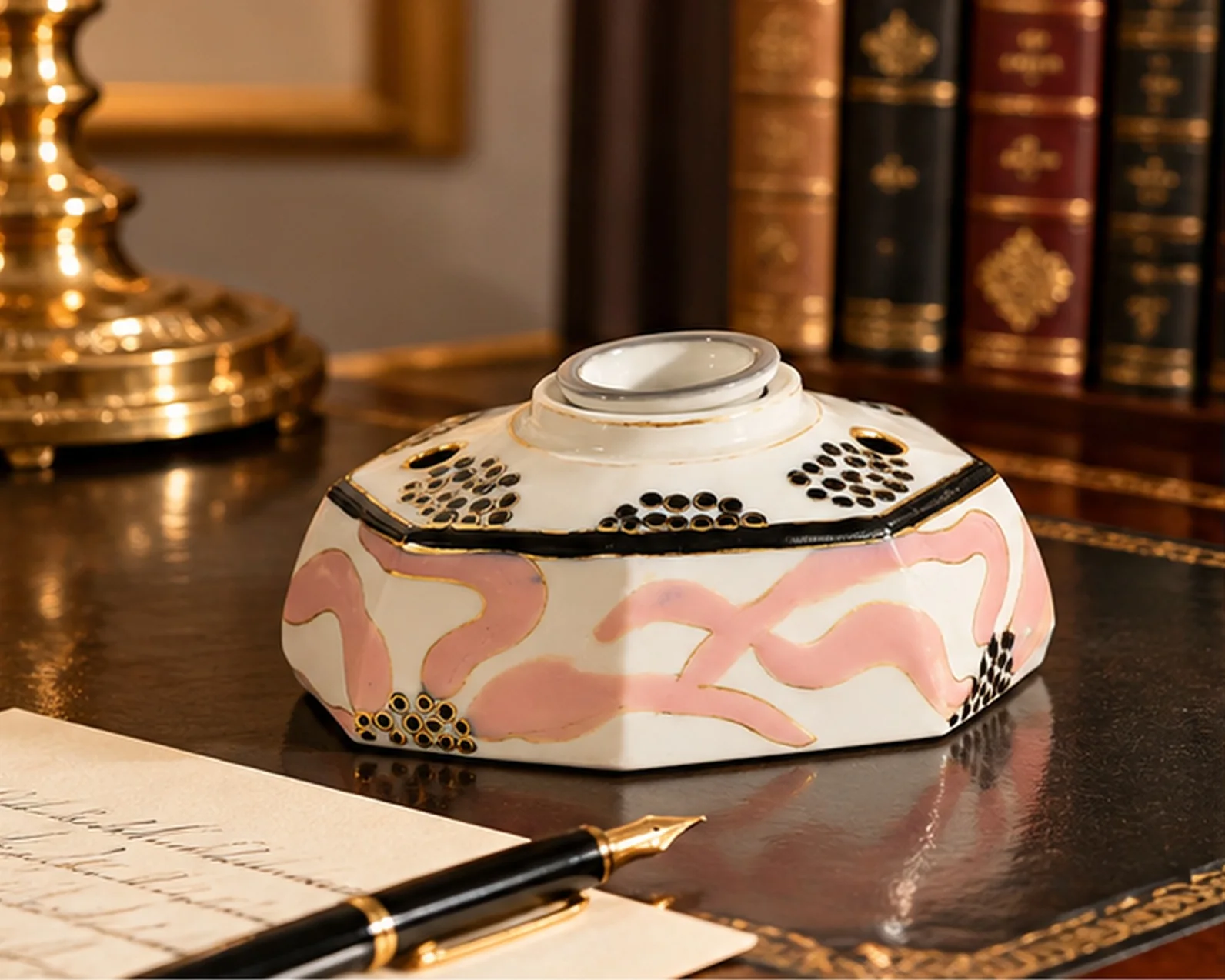
Two pieces in the gallery illustrate the two faces of Limoges described here. The set of 4 Limoges plates with a gilt rim, twentieth century, in white porcelain with a scalloped edge and a gilt monogram, recalls the tradition of services commissioned for a family or a household. The Tharaud Limoges Art Deco inkwell, from the 1930s, shows the colour within the glaze that made Camille Tharaud's reputation. You will find more pieces in our Tableware collection.
Do you own a piece of Limoges porcelain and would like to know more about its marks? Send us photographs of the underside and the decoration through our appraisal page, and we will help you read them.