A flash of gold trapped in glass, flakes of silver that seem to float in the mass: glass with gold and silver leaf inclusions has fascinated people since antiquity. Yet behind this single effect lie very different techniques, from gold leaf sealed between two walls of glass to the flakes broken up by glassblowing in Murano, not forgetting aventurine, whose golden sparkle owes nothing to gold. Here is how to find your way through them, and how to recognise a genuine metal-leaf inclusion.
Inclusion, gilding, églomisé: what are we talking about?
First, three families of decoration need to be told apart, as they are often confused:
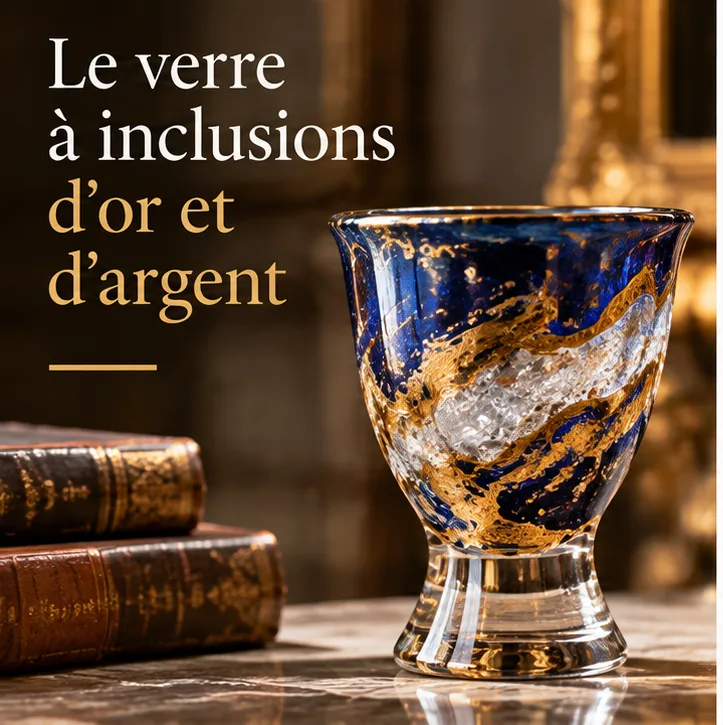
- inclusion, where a sheet of beaten metal, gold or silver, is enclosed within the glass itself or between two layers of glass: the metal is protected and seen through the glass;
- surface gilding, where gold is applied to the outer face of the glass: you can touch it, and it wears over time;
- verre églomisé, where gold is laid on the back of a single pane of glass and viewed through it. The name comes from Jean-Baptiste Glomy (1711-1786), who brought the process back into fashion in the 18th century.
Strictly speaking, églomisé is therefore not an inclusion: the metal remains exposed on the back of the glass.
The origins: gold glass of late antiquity
The idea of enclosing gold leaf between two layers of glass is very old. Examples are found in Hellenistic Greece, and the technique became characteristic of Roman glass of the late Empire, in the 3rd and 4th centuries AD. A disc of glass was cut, gold leaf was glued to it, and the design was made by scraping away the leaf; the disc was then fused to the base of a blown cup or bowl.
The best-known gold glasses are the roundels found in Rome: cut from the bases of vessels, they were set into the walls of the catacombs to mark burials. Around five hundred such pieces have been recorded. In the 19th century these ancient glasses were imitated, copied and sometimes forged, mostly in Murano, notably by the Salviati firm: one more reason to be cautious when faced with an "ancient gold glass".
Bohemian Zwischengoldglas: gold between two walls
In the 18th century, Bohemia and Germany revived gold enclosed between two layers of glass under the name Zwischengoldglas, literally "gold between glass". The difference from Roman glass is essential: the two layers are no longer fused together, but fitted and glued.
The Victoria and Albert Museum in London describes the process for a mid-18th-century Bohemian beaker: two glass beakers are ground and polished so that the inner one fits exactly inside the outer; the gold leaf is applied to the inner beaker and engraved, then the two are joined and sealed at the rim. The museum stresses that this was a very difficult and time-consuming process that made the glasses extremely expensive. Its example, decorated with St George and the Dragon among scrolls and grotesques, has a base medallion backed with ruby lacquer.
The Courtauld in London places the first description of the technique for beakers in 1679, in the Ars Vitraria Experimentalis by the alchemist Johann Kunckel. It presents a pair of facet-cut beakers made in Bohemia between 1720 and 1740, sealed with colophony, a pine resin, and with red bases. Hunts, saints, gardens, castles and monasteries are among the usual subjects of these glasses. Readers interested in Central European glass will find more context in our article on Bohemian crystal.
Murano: gold leaf in blown glass
In Murano, gold leaf, foglia d'oro, is worked hot. The principle usually described is this: the leaf is applied by hand to the still-hot glass, covered with another layer of glass, and the piece is then blown and expanded. As it stretches with the glass, the leaf breaks into flakes and irregular fragments, more or less dense, which create the characteristic shimmer. What holds for gold holds, in principle, for silver leaf, foglia d'argento.
The Murano Glass Museum holds 20th-century examples of this work, such as a small opaque red vase with bubbles and gold leaf designed by Carlo Scarpa for the Cappellin & C. glassworks around 1930, in blown glass and gold leaf.
For recent glass, the Consorzio Promovetro Murano manages the collective trademark Vetro Artistico® Murano, established by the Veneto Region under Law no. 70 of 23 December 1994. It takes the form of a red or blue adhesive label, depending on the type of work, bearing the maker's code; since 2016 it has also carried a serial number and a data matrix code identifying each piece.
Aventurine: a golden sparkle that owes nothing to gold
Aventurine, or avventurina, is often wrongly described as glass "with gold flakes". The Victoria and Albert Museum is clear: its sparkle comes from tiny flat particles of copper dispersed in the glass. The Courtauld explains the process: copper oxide is added to the molten glass and reduced to metallic copper in the crucible; as it cools slowly, the copper forms small triangular and hexagonal crystals. The main difficulty lies in growing and spreading these crystals during that slow cooling.
Discovered by Venetian glassmakers in the 17th century, aventurine takes its name from the Italian avventura: the result depended partly on chance. It can be recognised by its very fine, regular glittering points, coppery to golden in tone, spread throughout the mass, rather than by large torn sheets.
And on the Côte d'Azur? The Verrerie de Biot
About twenty kilometres from Nice, the Verrerie de Biot is the benchmark for blown glass on the Riviera. Founded in 1956, it owes its signature to the master glassmaker Éloi Monod, who turned the bubble, long seen as a flaw, into an aesthetic feature: the famous bubble glass (verre bullé). The house is now run by the Lechaczynski family.
Its official presentation highlights the bubble, then other creations such as frosted glass, but not gold or silver leaf inclusions. A piece of Biot bubble glass is therefore not, by definition, a metal-inclusion glass; if a piece combines the two, only its label or its seller can confirm its origin.
How to recognise a genuine leaf inclusion
No single sign is enough, but a few observations help tell the difference:
- Touch. A genuine inclusion lies beneath a smooth layer of glass: your finger feels neither relief nor grain. Gold you can feel under a fingernail, or that wears away at the rim and where the piece is handled, is surface gilding.
- The look of the fragments. In blown glass, the leaf appears as irregular fragments with torn edges, sometimes stretched in the direction of blowing. Metallic paint or added glitter tends to look uniform, with evenly sized particles or a continuous film.
- The sparkle. Tiny, regular, coppery points spread throughout the mass suggest aventurine, which contains no gold.
- The double wall. On a Zwischengoldglas, you can see the join of the two beakers and the thickness of the double wall at the rim.
- Marks. On recent glass, the Vetro Artistico® Murano label and its code indicate the origin; a "Murano" sticker without a code proves nothing, and the absence of a label proves nothing either.
To tell glass from crystal, our article Glass or crystal: telling the difference offers further pointers. And for dating or attribution, nothing replaces a direct examination of the piece.
Caring for glass with inclusions
These tips are a matter of caution rather than hard rules:
- no dishwasher: heat, detergents and knocks are best avoided for any antique decorative glass;
- wash by hand in lukewarm water with mild soap, without an abrasive sponge, then dry with a soft cloth;
- avoid sudden changes in temperature, which can weaken blown glass;
- for a Zwischengoldglas, whose walls are glued, it is best to avoid any soaking: a barely damp cloth on the outside is enough;
- for verre églomisé, never wet or rub the back, where the decoration lies.
Frequently asked questions
Is the gold in Murano glass real gold? Foglia d'oro is beaten gold leaf, applied to the glass and then worked hot. Aventurine, on the other hand, often described as "golden", owes its sparkle to copper crystals, not gold. Only the seller, the original label or an examination can tell you what a given piece contains.
What is the difference between glass with inclusions and verre églomisé? In glass with inclusions, the metal leaf is enclosed within the glass or between two layers of glass. In verre églomisé, the gold is laid on the back of a single pane and remains exposed on that side.
What is Zwischengoldglas? It is a technique from Bohemia and Germany revived in the 18th century: an engraved gold leaf is enclosed between two beakers fitted one inside the other, then sealed at the rim. The Victoria and Albert Museum in London holds a mid-18th-century example.
Does the Verrerie de Biot make gold leaf glass? Its signature since 1956 has been bubble glass, and its official presentation does not feature gold or silver leaf glass. For a specific piece, the label or the mark engraved underneath remains the best guide.
How can I tell whether my glass with inclusions is old? There is no simple test: style, quality of the glass, wear, marks and provenance all need to be weighed together. A specialist remains the safest route.
Glass at the gallery
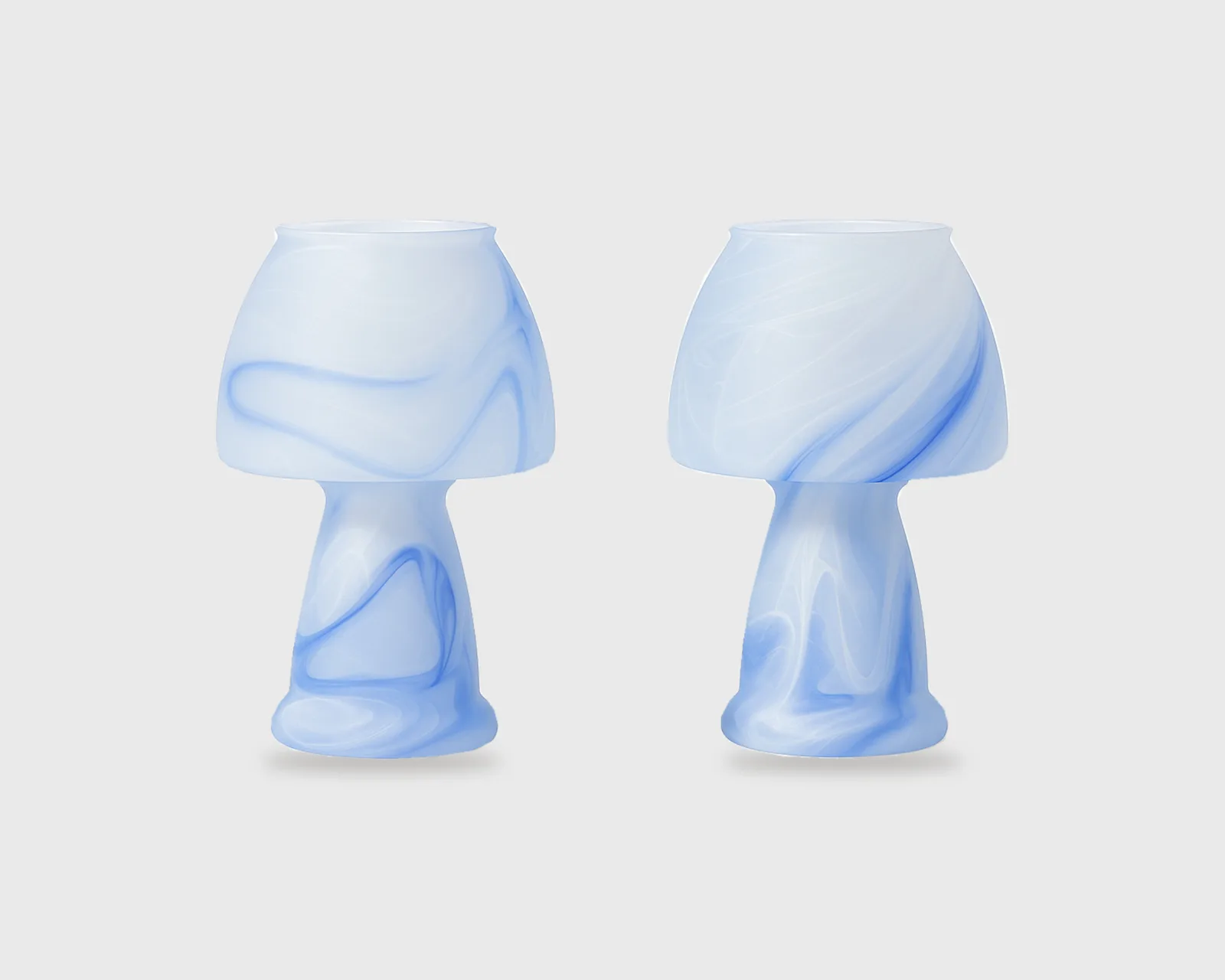
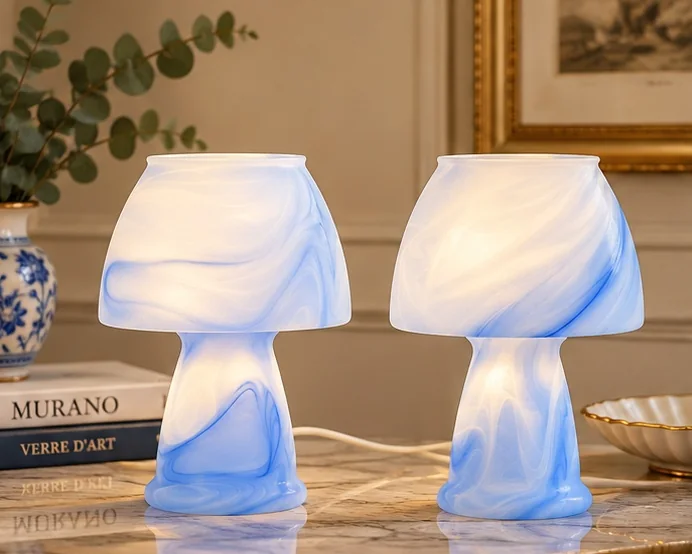
The gallery, based in Nice, currently offers a pair of blue and white glass mushroom lamps, attributed to Murano: not a gold-inclusion glass, but a fine example of blown glass, with a blue and white swirl decoration, in the Italian tradition of mushroom lamps. More pieces are waiting in the Glass and crystal collection. Do you own a piece of gold or silver leaf glass and would like to know more? Our appraisal service is here to help.