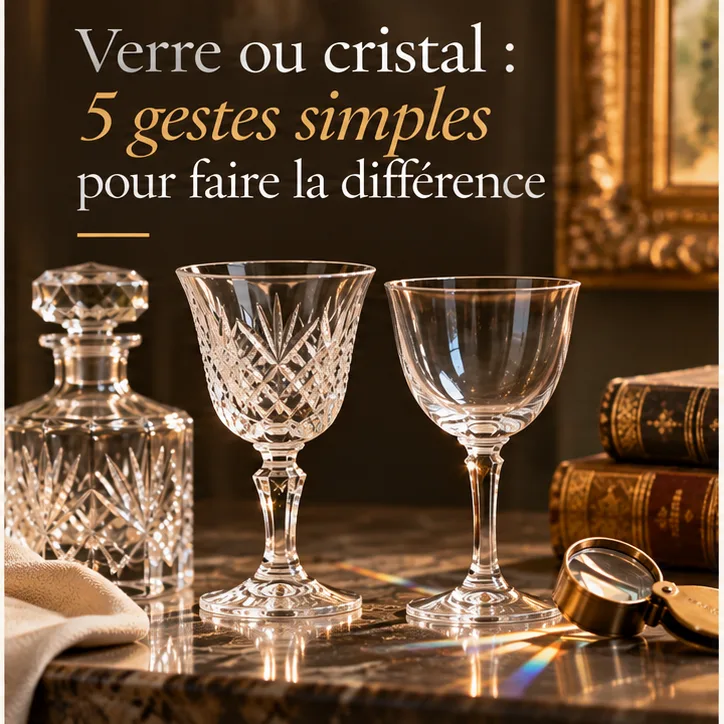
Crystal is a glass whose composition is defined by law: in Europe, the name “lead crystal” is reserved for glass containing at least 24% lead oxide, and “full lead crystal” (cristal supérieur) for glass containing at least 30%. At home, five simple checks give useful clues: read the label or mark, weigh the piece in your hand, tap it, study the light and shine an ultraviolet lamp on it. None of these is proof on its own; only laboratory analysis can classify a piece with certainty.
What the law says: “crystal” is a protected name
“Crystal” is not a different material from glass: it is glass of a particular composition. In this sense the word goes back to the Venetian “cristallo”, the name Murano glassmakers gave to a very clear glass imitating rock crystal. Crystal objects are in fact made of an amorphous material: they are not crystals in the physicist's sense.
European Directive 69/493/EEC of 15 December 1969, devoted to “crystal glass”, set out four categories, with the stated aim of protecting both the buyer against fraud and the manufacturer who complies with the rules:
- Full lead crystal 30%: at least 30% lead oxide (PbO) and a density of at least 3.00.
- Lead crystal 24%: at least 24% lead oxide and a density of at least 2.90.
- Crystallin (crystal glass): at least 10% oxides of zinc, barium, lead or potassium, singly or together, a density of at least 2.45 and a refractive index of at least 1.520.
- Sound glass (verre sonore): at least 10% oxides of barium, lead or potassium, singly or together, a density of at least 2.40 and a specified surface hardness.
These names may not be used commercially for products that lack the corresponding characteristics. Note that a “crystallin” or a “sound glass” may contain no lead at all: oxides of zinc, barium or potassium are enough.
In France, these rules are set out in standard NF B30-004, “Cristal, cristallin et verre sonore”. Its April 2023 edition, made mandatory by a ministerial order of 24 May 2024, adds a new name: “lead-free crystal” (cristal sans plomb), with its own technical characteristics. In lead-free crystal, lead oxide is generally replaced by other oxides, such as those of barium, zinc or potassium. In other words, lead is no longer the only route to crystal, which makes home tests even harder to interpret.
Check 1: look for a label, mark or signature
The 1969 directive provides for optional identifying symbols, which may appear on the same label as the name:
- a round gold label at least 1 cm across for full lead crystal 30% and lead crystal 24%;
- a square silver label for crystallin;
- a triangular silver label for sound glass.
On an old or much-used piece these labels have often gone. Sometimes an engraved signature or a factory mark remains: look under the foot or the base, with a magnifying glass and raking light. A signature tells you about a piece's origin; on its own, it does not tell you which category the glass belongs to. Note too that, under the directive, a trade mark containing the word “crystal” must be preceded by the exact description of the product: a brand name is not a definition.
Check 2: weigh it in your hand
Lead makes glass heavier. The directive's thresholds make this clear: a density of at least 2.90 for lead crystal, against a minimum of 2.40 for sound glass. Typical lead crystal has a density of about 3.1, whereas ordinary (soda-lime) glass is generally no more than 2.4: for the same volume, you can feel the difference in your hand.
The most telling method is to compare two objects of the same shape and size, one in each hand. Beware of thick pieces, though: a heavy piece of ordinary glass may feel weighty simply because it contains a lot of material.
Check 3: tap it
Lead crystal is known for its resonance: when struck, it gives a ringing sound, unlike ordinary glass. Hold the glass by the foot, without touching the bowl, and flick the rim lightly with a fingernail. A clear, lingering note is a good sign.
It is a clue, however, not proof: the law itself created a category called “sound glass”, which may contain only 10% oxides and no lead at all. And avoid knocking two pieces together to test them.
Check 4: study the light
Lead raises the refractive index of glass, and with it the glass's brilliance and clarity. It also increases dispersion, the splitting of light into colours. Hold the piece up to a window or under a lamp and turn it slowly: on cut crystal, the facets throw back crisp flashes and iridescent reflections.
Look at the cutting too. Softer than ordinary glass, crystal is easier to cut, traditionally on the wheel or with acid; this is what makes the deep patterns and sharp edges of fine table services possible. Health Canada points out, however, that while lead crystal can look thinner and brighter, and feel heavier, than ordinary glassware, it is not always easy to tell whether an item is lead crystal, lead-free crystal or ordinary glass.
Check 5: use an ultraviolet lamp
This test is described by the research library of the Corning Museum of Glass: lead produces a strong icy-blue fluorescence under ultraviolet light, visible under both long-wave and short-wave lamps; it becomes noticeable from around 5% lead and is strong by about 10 to 15%. Conversely, a weak to moderate yellowish-green fluorescence usually indicates manganese added as a decoloriser: it is a common response in non-lead glasses, and the scientist Robert Brill says he does not recall ever seeing green fluorescence in a lead glass. A bright, intense green, for its part, points to uranium.
Carry out the test in the dark, and do not mistake the lamp's purple reflection on the surface for fluorescence. Interpretation remains tricky: other elements fluoresce too, and lead-free crystal, by definition, will not show the fluorescence caused by lead.
What these checks cannot prove
None of these five checks is enough to classify a piece. The directive is explicit: only the methods described in its Annex II are valid for verifying that a product matches its name, namely chemical analysis of the oxides, density measured on a hydrostatic balance, refractive index measured with a refractometer, and a microhardness test. In practice, a set of consistent clues (weight, sound, brilliance, blue fluorescence) makes lead crystal a plausible hypothesis without proving it. For a piece that matters, ask a professional, for example through our appraisal page.
Using lead crystal safely
Lead crystal can release some of its lead into food and drink. Health Canada draws simple recommendations from this:
- Serve, don't store. Transfer is lower during brief use, such as over a meal, and rises with contact time, for example fruit juice left overnight or port kept for weeks in a decanter.
- Take care with acidic drinks. Fruit juices, soft drinks and wine take up more lead than less acidic foods such as cheese, nuts or milk.
- Protect the most vulnerable. Infants and children are the most sensitive to the effects of lead, which can also pass to the baby during pregnancy or breastfeeding: for them, choose lead-free tableware.
- Wash by hand. Warm water, a mild detergent and a soft cloth or sponge, to avoid damaging the surface, which can increase lead transfer.
- Prepare new pieces. The agency advises soaking new lead crystal in vinegar for twenty-four hours, then rinsing it thoroughly before use.
Finally, Health Canada advises using it only from time to time, for example on special occasions.
Train your eye on our pieces
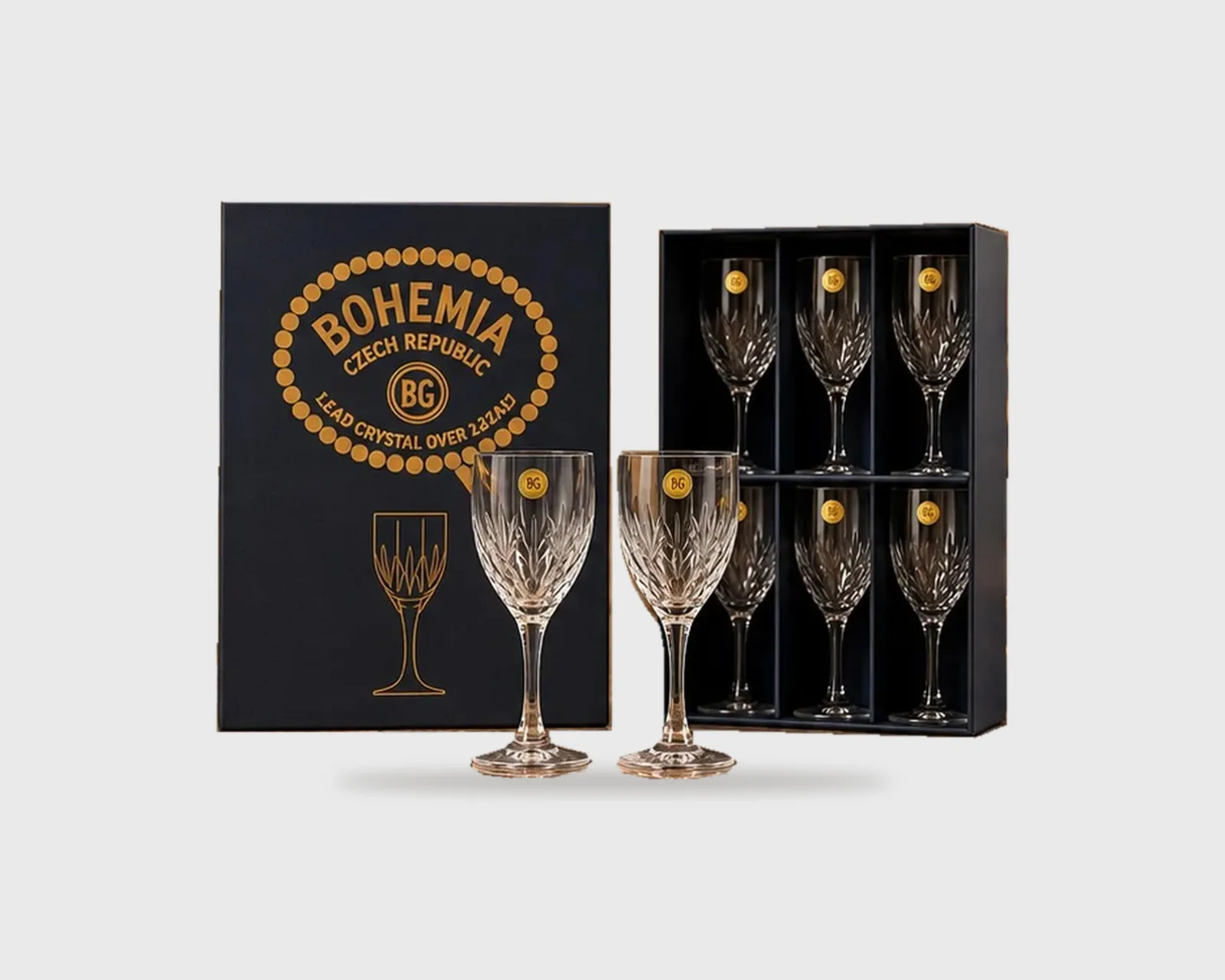
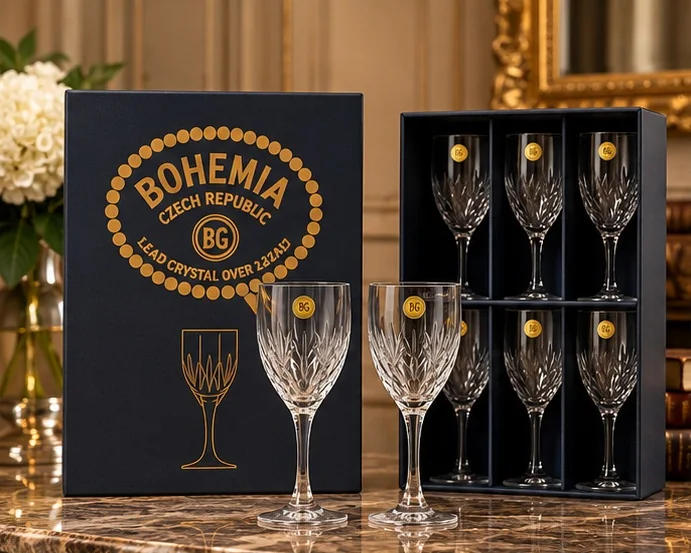
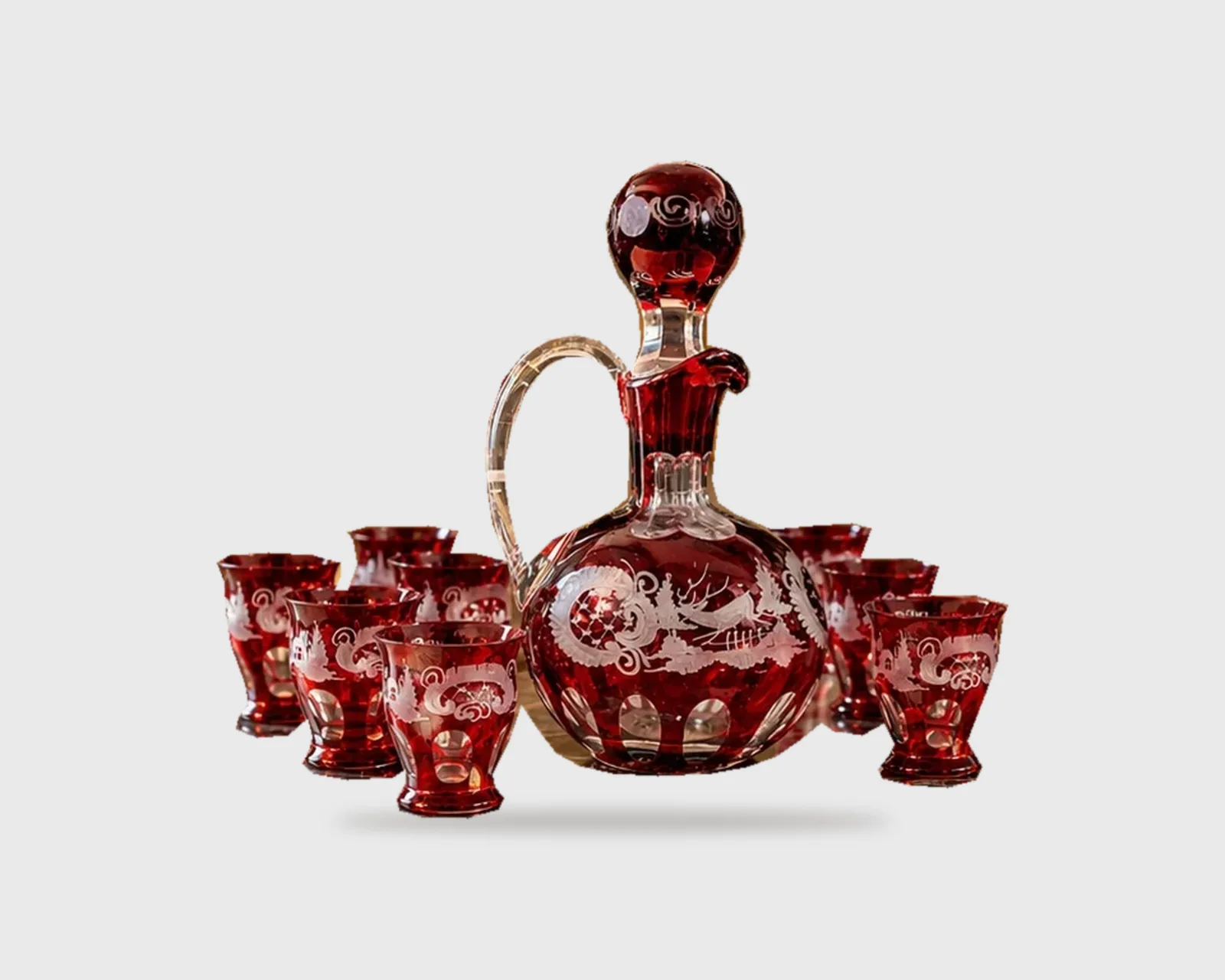
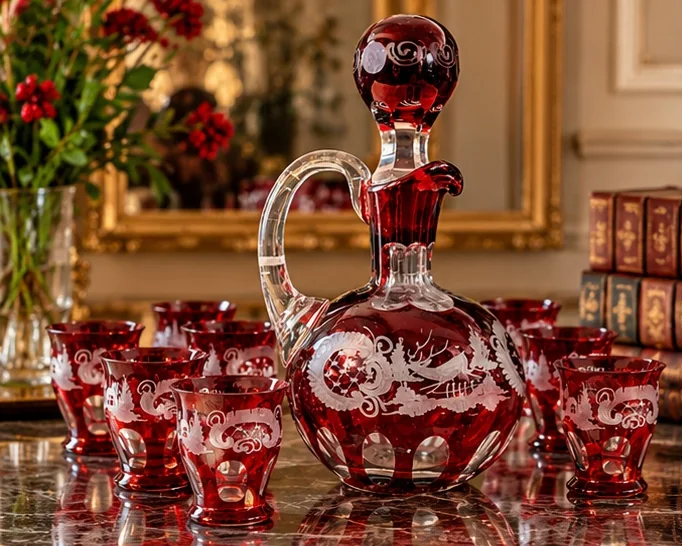
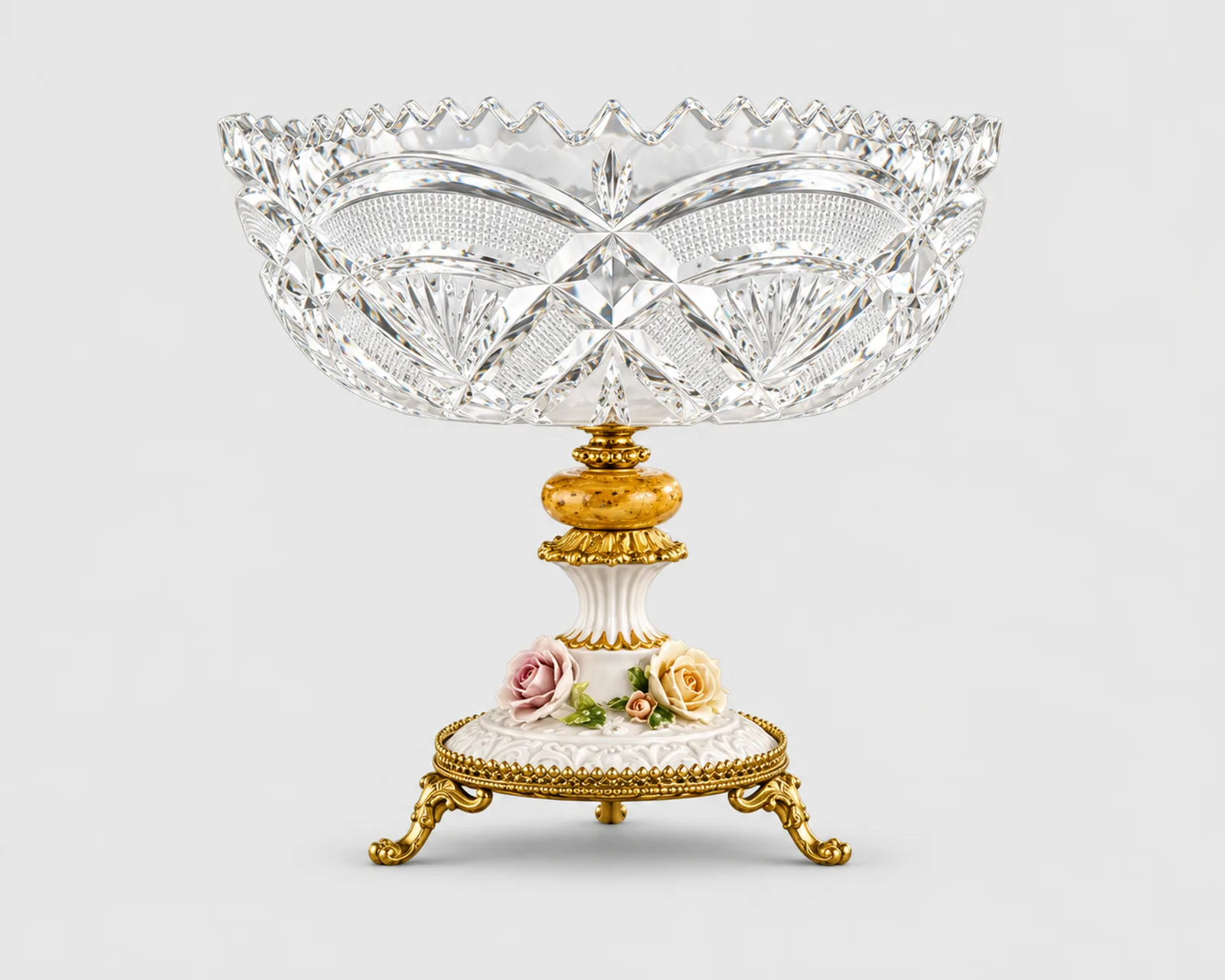
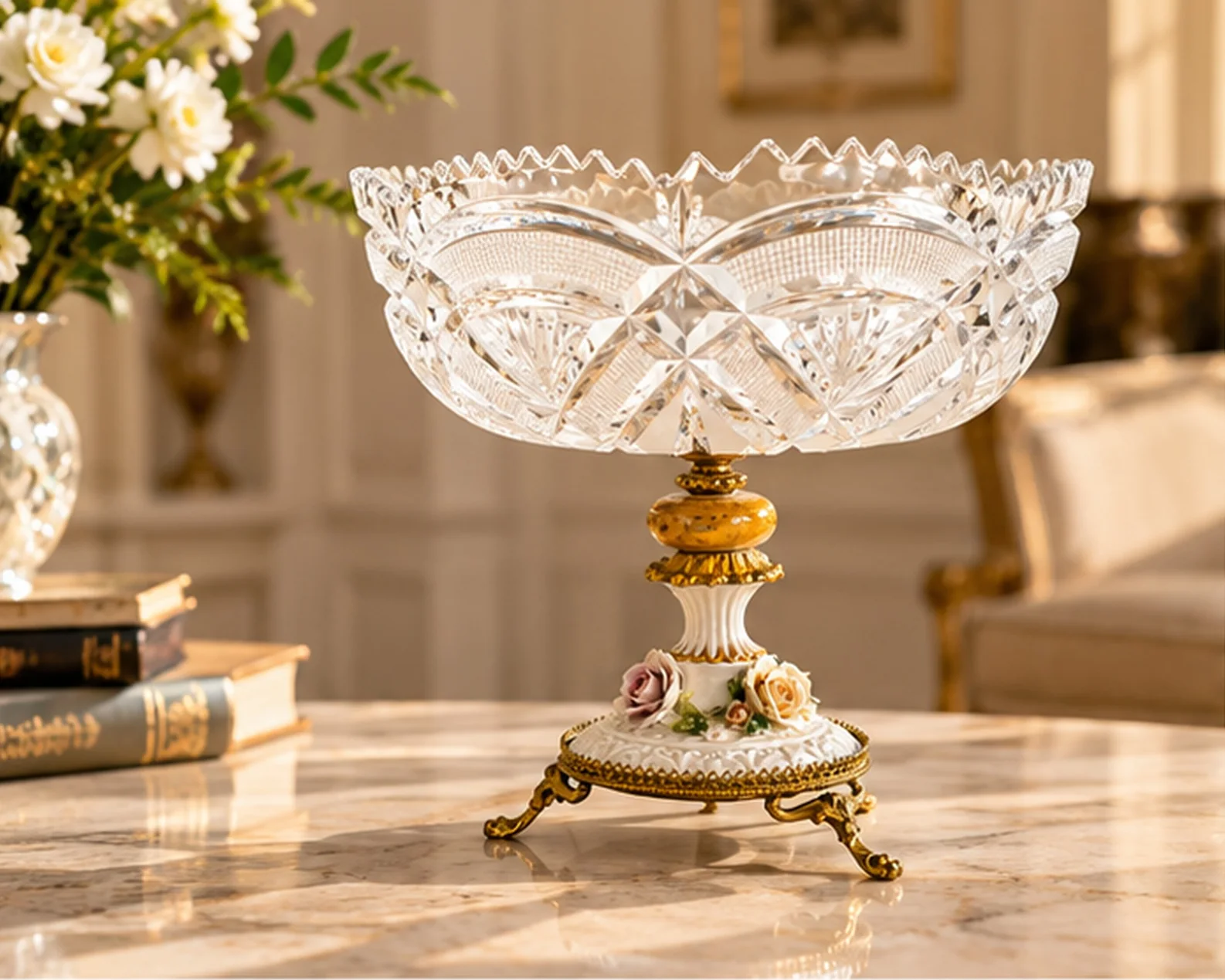
There is no substitute for looking at real objects. The set of 12 Bohemia crystal glasses brings together twelve stemmed glasses cut with a palm motif, each with its authenticity label, in their original boxes: a good example of labels that have survived. The Bohemian crystal liqueur set pairs a decanter and eight glasses in red crystal cased over clear crystal, whose engraved decoration reveals the colourless crystal beneath the red layer. The cut crystal and decorated porcelain tazza shows how a scalloped cut rim plays with the light, and the set of Tiffany & Co. cut crystal serving dishes bears the engraved Tiffany & Co. mark; their wide rims are cut with a wreath of foliage.
Frequently asked questions
What is the minimum lead content of crystal? Under European Directive 69/493/EEC, the name “lead crystal” requires at least 24% lead oxide and “full lead crystal” at least 30%. The “crystallin” and “sound glass” categories require at least 10% oxides, with or without lead. In France, the 2023 edition of standard NF B30-004 added the name “lead-free crystal”.
Is the sound test enough to recognise crystal? No. Lead crystal rings clearly when struck, but other oxide-rich glasses ring too: the regulations even call one category “sound glass”. Sound is a clue to be checked against weight, brilliance and fluorescence.
What does a UV lamp show on crystal? Lead gives an icy-blue fluorescence, noticeable from around 5% lead according to the Corning Museum of Glass. A weak yellowish-green glow suggests instead a lead-free glass decolourised with manganese. The test points you in a direction, but only laboratory analysis can settle the question.
Can I keep wine or spirits in a crystal decanter? Health Canada recommends using lead crystal only for serving, never for storing food or drink, as lead transfer increases with contact time and the acidity of the drink. So fill the decanter for the meal, then empty it.
Can crystal go in the dishwasher? For lead crystal, Health Canada advises washing by hand in warm water with a mild detergent and a soft sponge, so as not to damage the surface. Its guidance does not specifically mention dishwashers.
In short, weight, sound, light and a UV lamp can tell you a great deal, provided you combine them and bear their limits in mind. To practise, browse our glass and crystal collection; for a piece that intrigues you, our appraisal page explains how to submit it to us.