To clean an antique without damaging it, always begin with the gentlest step: dry dusting with a cotton cloth or a soft brush, and stop there if that is enough. Each material then has its own rules: very little water on old finishes, no polish on gilt bronze, and no dishwasher for crystal or faience. As soon as decoration starts to lift or an old repair shows, it is time to hand over to a conservator.
The principle: as little as possible, as gently as possible
Conservators say it again and again: much of the damage comes from handling and from the surroundings. The Canadian Conservation Institute (CCI) notes that the main causes of damage to furniture are careless handling and environmental conditions, and that the best care is simply to keep the environment stable.
A few habits apply to every material:
- test any cleaning method on a small hidden area before using it on the whole piece;
- avoid commercial ‘restorers’ and household cleaners;
- lift an object with both hands, by its strongest part, never by a handle, spout or knob;
- never try to make an antique look ‘new’: its original surface is part of its history and its value.
The setting: light, heat and humidity
Where a piece stands matters before any cleaning. According to the CCI, light is a natural enemy of all organic materials, and the damage it does is cumulative and irreversible, so furniture, textiles and painted wood are best kept out of direct sun, with the help of blinds or curtains.
Heat and swings in humidity are just as harmful. The CCI advises against placing furniture beside a fireplace or radiator, or over a heating vent, and against attics, cellars and garages, where conditions change constantly. Wood swells and shrinks with humidity, which can crack and lift finishes; conversely, no oil or product will stop wood drying out if the air is too dry, while overly damp air encourages mould.
Metals prefer dry air: according to the CCI, above 65 % relative humidity enough moisture collects on their surface to support corrosion. As for glass and ceramics, the CCI advises against storing or displaying them where temperature and humidity change sharply or rapidly.
Wood and its finishes: dust, wax rarely, never strip
The original finish of a piece of furniture has, says the CCI, historical, aesthetic and financial value. Stripping or refinishing it wipes that value away: it is the first thing not to do.
Routine care comes down to a few steps:
- Dust regularly with a soft cloth. The CCI points out that a great deal of furniture made before the First World War is sensitive to water: dust it with a dry cloth, then buff it.
- Test before wetting. If a sound finish seems to need more thorough cleaning, the CCI suggests first rubbing a hidden area with a barely damp cotton swab. If it picks up brown or yellow, or if the finish whitens as it dries, do not use water.
- Wax rarely. Use a paste wax with no colour or fragrance, applied in thin coats with a lint-free cloth, then buffed once it has turned matt. The CCI recommends a microcrystalline wax, no more than once a year, on surfaces that are handled, avoiding build-up around the hardware.
- Forget polishes and oils. According to the CCI, most commercial restorers contain waxes, oils or silicone that leave surfaces sticky and attract dust. And, contrary to popular belief, wood does not need to be ‘fed’.
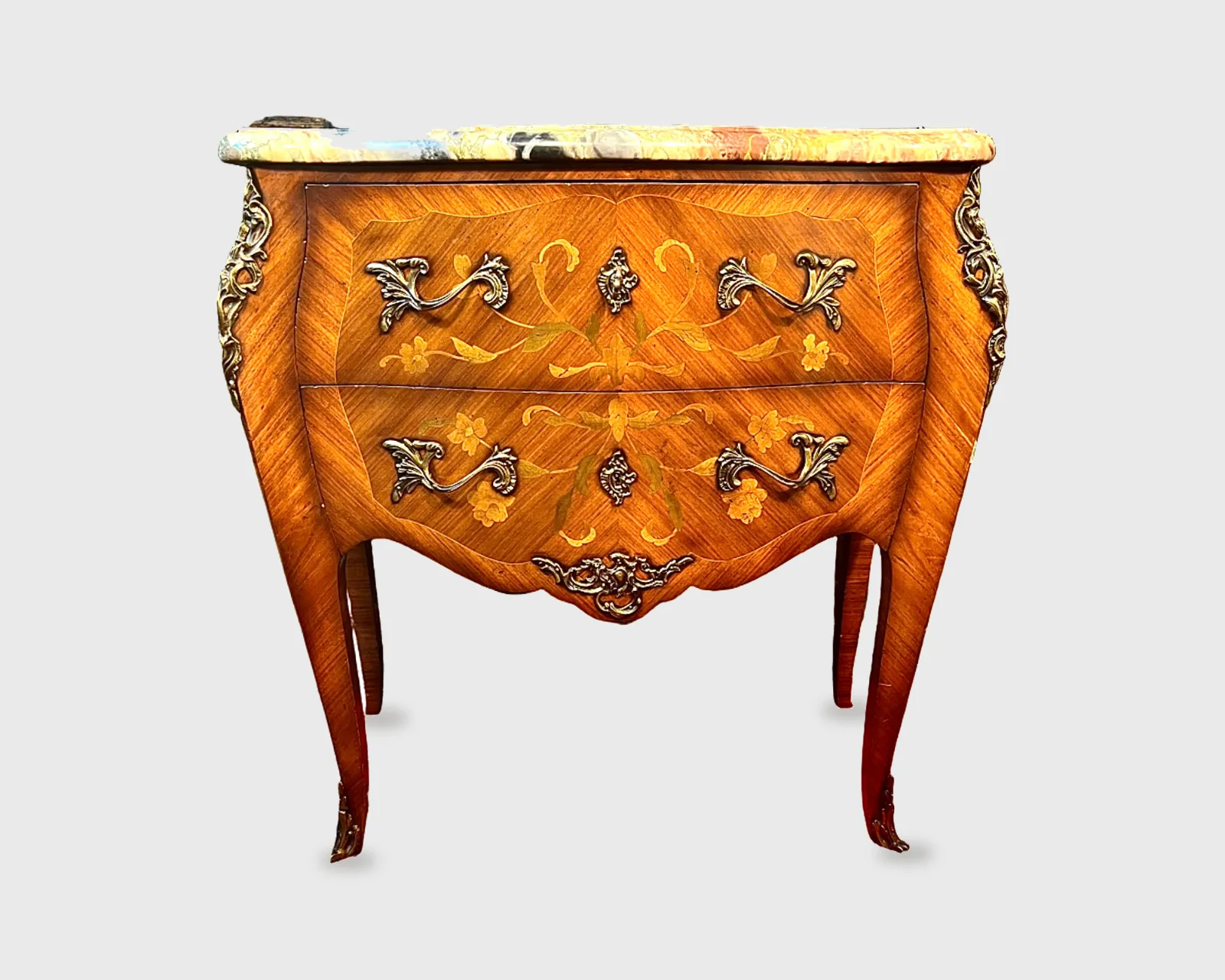
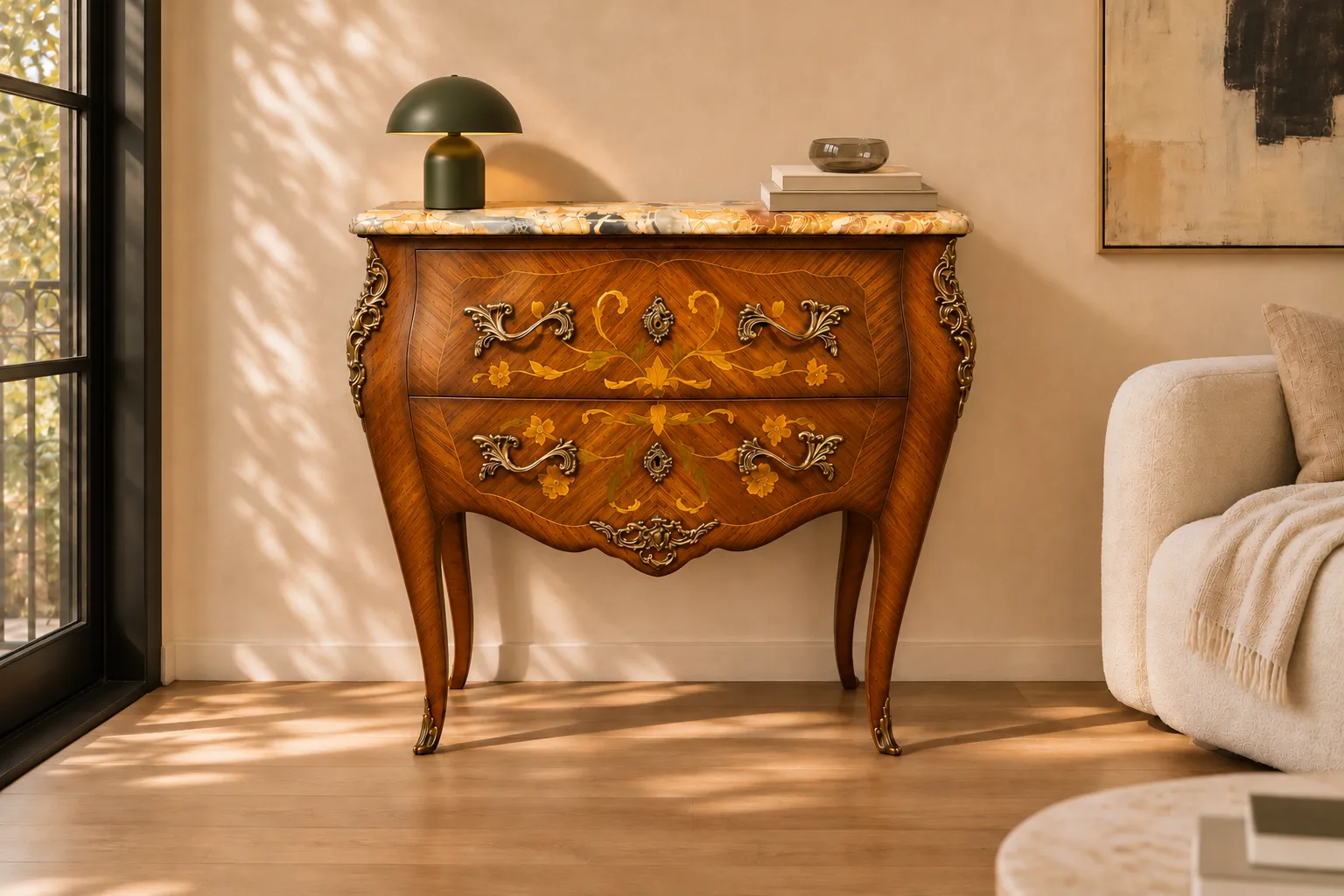
To move a piece, take out the drawers, lift rather than drag, and take off a marble top to carry it upright, as the CCI recommends. That applies, for instance, to a piece like our serpentine marquetry commode with marble top, whose floral marquetry needs nothing more than a soft cloth.
Bronze and gilt bronze: dust, and nothing else
Gilt bronze, known in English as ormolu, was traditionally made by applying an amalgam of gold and mercury to bronze and then heating the piece to drive off the mercury, leaving only the gold. Gilding of this kind is a surface layer, and it wears away with rubbing.
The CCI notes that a metal’s patina is an aesthetically pleasing layer that enhances the object and should not be removed, and that thin finishes can be damaged by even a small amount of abrasion or chemical cleaning. It also notes that green spots on copper alloys are often the result of contamination left by inappropriate polishing.
In practice:
- avoid touching metal with bare hands; the CCI recommends clean gloves, nitrile for instance;
- dust with a very soft brush, its metal ferrule wrapped in tape to avoid accidental knocks, as the UK’s Institute of Conservation (Icon) advises in its guidance on frames and gilding;
- dust sparingly: for Icon, once a year is enough on a gilded surface, because the action itself gradually wears the gilding away;
- do not use household products: Icon warns that inappropriate cleaning agents stain and damage gilded surfaces, and advises against ‘gold’ touch-up paints;
- never polish the mounts on a piece of furniture in place: the CCI warns that abrasive or ammonia-based metal cleaners damage the surrounding wood and finish.
Anything beyond dusting a gilt bronze is a job for a conservator. A gilt bronze sculpture such as the one by Michel Jarry is best kept away from damp and dusted with a brush.
Silver: tarnish is not a disease
The black film that creeps over silver is, the CCI explains, a thin layer of silver sulphide, formed by contact with sulphur compounds in the air such as hydrogen sulphide. The CCI advises against frequent polishing: every polish also removes a little of the underlying metal.
When you do want to bring back the shine, the CCI Note on the care of silver sets out a cautious method:
- handle with clean cotton gloves, as the salts and oils in skin leave fingerprints;
- look for hallmarks to tell solid silver from silver plate: on silver-plated objects, the CCI warns, any method of removing tarnish can cause serious damage;
- wash in distilled water with a mild detergent, rinse and dry straight away, without wetting wooden, bone or ivory handles or felt;
- polish with the least abrasive product possible: a silver cloth first, then a gentle paste; the CCI suggests a paste of precipitated calcium carbonate and advises against general metal polishes, which are more abrasive than silver polishes;
- never use a dip, or the aluminium foil and sodium carbonate method, on an object with soldered hollow parts.
To slow tarnishing, the CCI suggests wrapping each piece in acid-free, sulphur-free tissue paper, then sealing it in a polyethylene bag; a cloth impregnated with silver particles gives extra protection. Varnishing or waxing silver, on the other hand, is generally not recommended.
Glass and crystal: by hand, in lukewarm water
The rule is clear: according to the CCI, fine glass and ceramics should not go in the dishwasher, because dishwasher detergents are extremely harsh.
Sturdy pieces can be washed by hand in lukewarm water with a drop of washing-up liquid, in a basin lined with a towel or a soft mat to cushion any knocks. Remove excess water with a soft cloth, then leave to air-dry. Lift pieces with both hands, never by a handle or spout, and avoid sudden changes of temperature.
The CCI adds a precaution specific to lead crystal: lead can leach into liquids. A crystal decanter is therefore for serving wine or liqueur, not for storing it over long periods. A set of cut-crystal glasses like our Bohemia service is washed one glass at a time, by hand.
Faience and ceramics: beware of crazed glaze
The Museum of Royal Worcester, in England, is unequivocal: never use a dishwasher for valued ceramics, nor household bleach or strong cleaning agents.
Its advice, written for porcelain:
- Dust with a lint-free cotton cloth, and a soft brush for raised decoration.
- Be wary of crazing. Cracks in the glaze are common and leave those areas porous and fragile. Avoid immersion and work instead with cotton wool lightly dampened in warm water, with a few drops of detergent per litre, rolling it over the surface rather than scrubbing.
- Keep washing in a bowl for pieces in good condition with no crazing, one at a time, in a plastic bowl lined with a tea towel. Rinse, then blot with a lint-free cloth.
- Look out for old repairs. Many old restoration materials are water-soluble, so washing can weaken them.
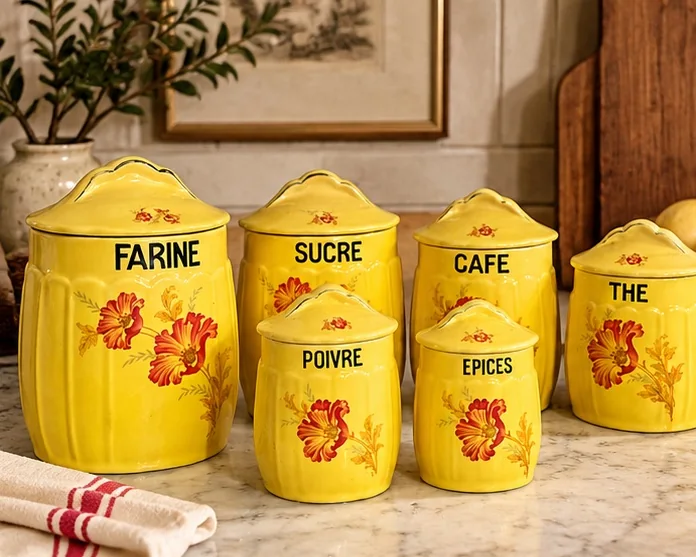
The CCI also recommends checking, before any cleaning, that painted or gilded decoration is secure, and leaving unglazed, soft or unevenly fired ceramics to a conservator. For display, it suggests wooden or plastic stands rather than spring-type metal hangers, and soft padding between stacked pieces. A set of faience spice jars is dusted in the same way, one jar at a time, lid removed.
When to call a conservator
The sources consulted agree: hand the object to a professional as soon as you go beyond routine care, in particular when:
- a varnish, lacquer or paint layer is lifting or flaking;
- a piece of furniture shows signs of insects (isolate it and wrap it while you wait for advice);
- a piece needs substantial repair or cleaning;
- gilding needs more than dusting;
- a ceramic is cracked or shows old repairs or adhesives;
- painted or gilded decoration is flaking.
Frequently asked questions
Should old furniture be ‘fed’ with oil? No. The Canadian Conservation Institute points out that wood does not need to be ‘fed’ and that no oil will stop wood drying out if the air is too dry. A stable environment, regular dusting and an occasional coat of neutral paste wax are enough; commercial oils and polishes simply build up on the surface.
Can antique crystal glasses go in the dishwasher? No. The CCI advises against the dishwasher for fine glass and ceramics because of its extremely harsh detergents. Wash them by hand in lukewarm water with a drop of washing-up liquid, in a towel-lined basin, then wipe gently and let them air-dry.
How do I remove tarnish from silver without damaging it? Start by washing in distilled water with a mild detergent. If the tarnish remains, use a silver cloth or a very mildly abrasive paste, such as the precipitated calcium carbonate recommended by the CCI, and avoid dips on pieces with soldered hollow parts. On silver plate, polish as little as possible.
Can I clean gilt bronze with a household cleaner? No. Gilding is a surface layer that wears away with rubbing, and inappropriate cleaning agents can stain or damage it. Limit yourself to dusting with a very soft brush, sparingly, and leave any deeper cleaning to a conservator.
Can crazed faience be washed? Carefully, and without immersion. Crazing leaves the glaze porous: the Museum of Royal Worcester recommends cotton wool lightly dampened with warm water, rolled over the surface without scrubbing. If there is an open crack or an old repair, ask a professional first.
In short
Caring for an antique is above all about protecting it: from light, heat, knocks and overly aggressive products. The gallery’s marquetry commode, gilt bronze sculpture or cut-crystal glasses need little care, provided it is gentle. For a fragile or damaged piece, or one whose material you are unsure of, our appraisal service can help you see clearly before you act.