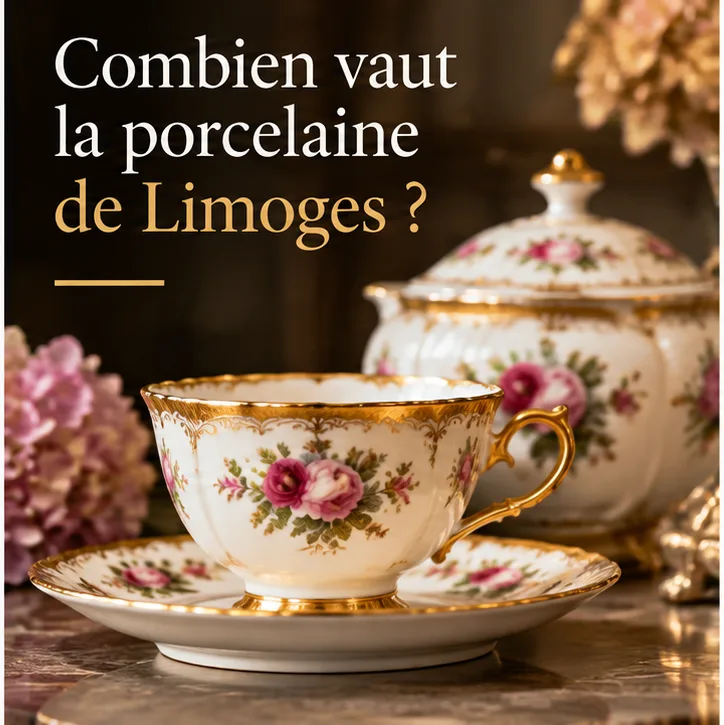
How much is Limoges porcelain worth? There is no single answer, because the word "Limoges" covers two and a half centuries of production, from exhibition pieces to mass-produced table services. A piece's value depends first on who made and decorated it, and when, then on how it is decorated, its condition, its rarity and its history. Here are the criteria that matter, the pitfalls to avoid and the steps to follow for a sound valuation.
Why Limoges porcelain is sought after
It all begins with a deposit of exceptionally pure kaolin, discovered in 1768 at Saint-Yrieix, south-west of Limoges, and immediately nicknamed "white gold". The first piece made from Limousin clay was produced in 1771. By around 1830, Limoges had replaced Paris as the main centre of private porcelain factories. In 1838 the American David Haviland set up a ceramics import business in New York; in 1842 he settled in Limoges and founded his own manufactory there, geared to the American market.
Its reputation was also built at exhibitions. The specification of the "Porcelaine de Limoges" geographical indication lists several prizes: Pouyat in London in 1851 for "its whites", Haviland in Paris in 1867 for a Gothic table sugar bowl, and the firm GDA in Paris in 1900, a gold medal for an Art Nouveau "Canton" service. In 1925, at the Exposition des Arts Décoratifs, the pavilion of the fire arts bore the inscription "Limoges, porcelain capital of the world".
This renown explains the demand, but also the sheer number of pieces marked "Limoges", whose value varies enormously.
What makes a piece valuable
The maker, the period and the artists. The underside of a piece tells you first about the manufactory and often about the decorating workshop (how to read these marks is explained in our article Limoges porcelain: reading the marks and dating a piece). Some houses and collaborations are particularly sought after:
- Haviland names among the artists and designers linked to its history Félix Bracquemond, Dammouse, Suzanne Lalique, Gauguin, Dufy, Sandoz, Kandinsky and Dalí. The Philadelphia Museum of Art holds a plate from the "Service Parisien" designed by Bracquemond, shown at the 1876 Centennial Exhibition in Philadelphia.
- Bernardaud, producing in Limoges since 1863, highlights artist services and editions, from Marc Chagall and Joan Miró to Jeff Koons.
- Designers and couturiers: the geographical indication specification mentions, among others, Roger Tallon for Raynaud, Marc Held for Coquet, Hubert de Givenchy for Haviland, Jean-Charles de Castelbajac for Raynaud and Carven for Bernardaud.
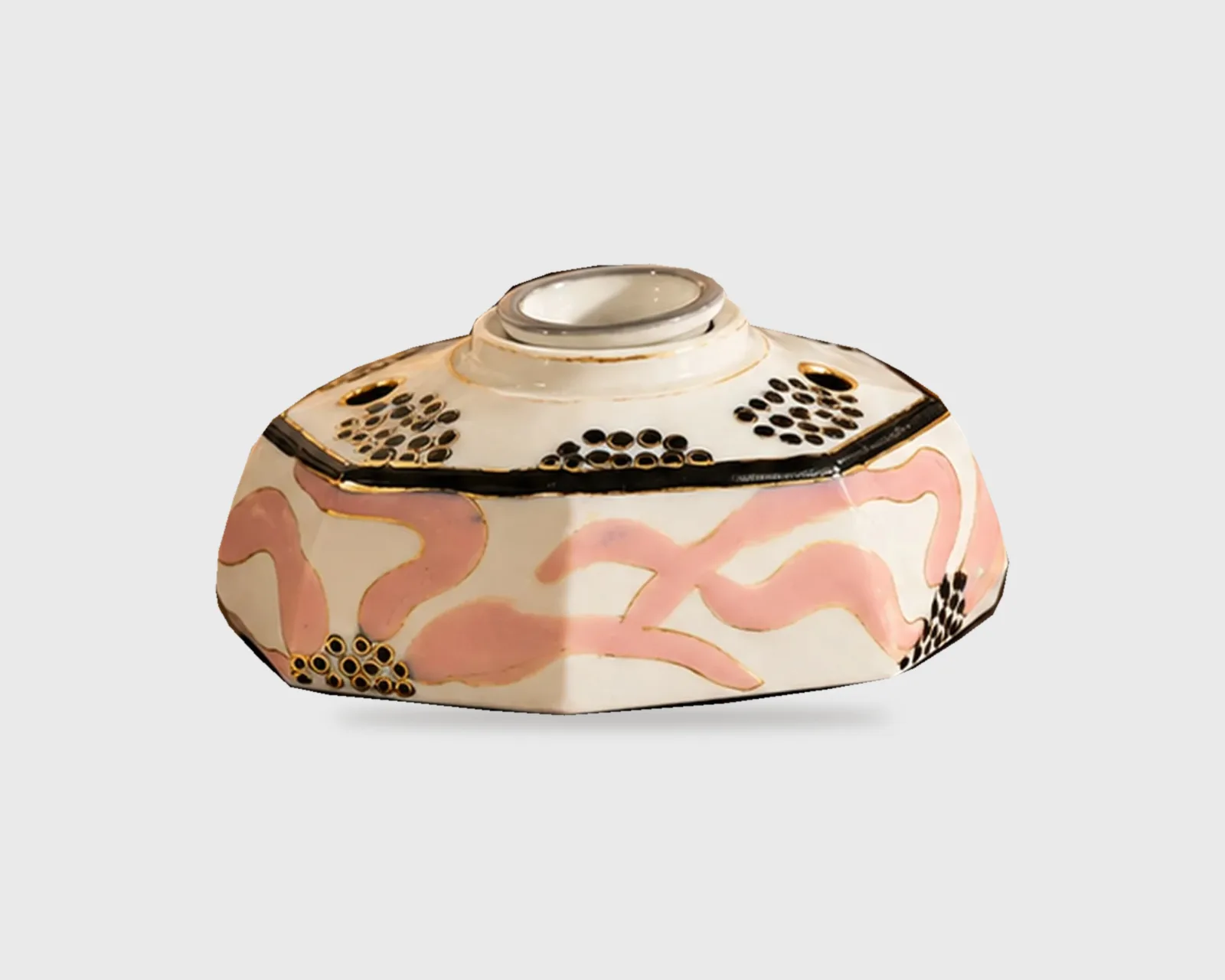
- Camille Tharaud (1878-1956), who ran his own factory from 1920, developed decoration in glaze coloured through its whole thickness and exhibited at the 1925 International Exhibition of Modern Decorative and Industrial Arts. The Musée national Adrien-Dubouché holds several of his vases.
A prestigious name is not everything: the great houses also produced everyday services. What counts is the combination of name, model, decoration and period.
The decoration technique. The specification distinguishes several families of decoration. Hand decoration with the brush includes lines and bands, motifs and gold highlights. Incrustation requires etching the glaze with acid or sandblasting, two layers of gold or platinum, two firings and burnishing with an agate. High-fire colours, such as cobalt "bleu de four", celadon or coloured glaze, are fired at the same temperature as the porcelain itself. Decal decoration, or chromolithography, developed in the 19th century and made it possible to multiply patterns.
A printed decoration does not, however, mean a piece without interest. For Bracquemond's "Service Parisien", the Philadelphia Museum of Art explains that each plate bears an etching and that the colour was printed by chromolithography, then a new process, chosen to ensure uniformity. A flask from the same series, offered at Christie's, was described as having printed and hand-gilded decoration. What matters is the quality of the drawing and execution, and the consistency of the piece with its maker and period.
The gilding. Gold plays a major role in Limoges porcelain: rims, motifs, monograms. Burnishing, a manual polishing with an agate, heightens its shine. Is the gold intact and bright, or worn by washing and cutlery? Tired gilding weighs on value.
Condition. Chips, cracks, wear to the decoration and gold, restorations: condition is decisive. Serious catalogues mention restorations; Christie's, for instance, noted "restorations to the foot" on the Haviland-Bracquemond flask. Examine each piece under raking light, rims included.
The completeness and consistency of a service. A service is judged on the number of pieces, the presence of serving pieces (tureen, platters, sauce boat), and the consistency of decoration and marks. The specification recalls that between the 1950s and 1970s young couples were given, through their wedding list, a complete 74-piece "modern" service: such services were made in large numbers, and their interest lies mainly in their condition, model and completeness.
Rarity and provenance. A rare shape, an exhibition model, a special commission or a documented provenance change everything. The Haviland-Bracquemond flask sold at Christie's was presented as the only known example of its shape and as coming from an important European collection. Invoices, family archives and exhibition or collection labels deserve to be kept with the piece.
What is generally of more modest value
Much of what turns up in attics and flea markets belongs to the everyday production of the 20th century: table services with standard printed decoration, cups and odd pieces, mass-produced decorative objects. These pieces often have charm and real practical quality, but their market value usually remains modest, especially when the service is incomplete or the gold worn. Small boxes and souvenir objects marked "Limoges" call for the same caution: everything depends on the quality of the decoration and the real origin, to be checked piece by piece.
The "Limoges" mark: what it guarantees today
The "Porcelaine de Limoges" geographical indication was approved by INPI, the French intellectual property office, on 1 December 2017. It requires both manufacture and decoration to take place in the Haute-Vienne département: a piece made in the area but decorated elsewhere cannot receive the stamp, nor can a piece made elsewhere and decorated in Limoges. In May 2026 it became the first French craft and industrial geographical indication protected throughout the European Union.
For current production, the "Porcelaine de Limoges" or "Limoges" stamp must be indelible and accompanied by the maker's name or a sign that identifies it. Stamps citing "Limoges" under other names are prohibited, and fraudulent use is punishable under the French Consumer Code by up to 2 years' imprisonment and a €300,000 fine.
These recent rules do not apply retroactively to antique pieces. They do, however, rest on long-standing case law: as early as 1983, France's Court of Cassation held that a buyer of decorated porcelain stamped "Limoges France" is entitled to believe that it was both made and decorated in Limoges.
Pitfalls to know about
- A name imitated for a long time. Before the First World War, an American earthenware factory in Ohio was already marking its products "Limoges China". As early as 1910, the commercial court of Bourges prohibited marking "Limoges" on porcelain made outside Limoges.
- Misleading names. The French Wikipedia article on Limoges porcelain reports sellers who knowingly mix imported products with local production, and a foreign industry presenting its material as "pâte de Limoges". A vague mention is no guarantee.
- A mark on its own. A mark must be read together with the shape, decoration, gilding and wear: a mark that does not match the style or period of the piece should prompt caution.
- No mark at all. This does not rule out a Limoges origin: even today, stamping can be optional, as some clients prefer to put their own brand forward. But an unmarked piece is harder to attribute, and therefore to value.
How to get Limoges porcelain valued
- Photograph the piece from the front, the side and underneath, with all marks clearly legible, as well as every defect.
- List a service: number of plates of each type, serving pieces, cups and saucers, missing or damaged pieces.
- Identify the manufactory and the decorating workshop from the marks, then the pattern name if it appears underneath.
- Compare with prices actually achieved, not asking prices: a listing shows what a seller hopes for, an auction result what a buyer paid. Check whether the result includes fees, and compare pieces of the same maker, model and condition.
- Consult a specialist as soon as a piece seems old, signed, rare or from a great house.
To train your eye, nothing beats public collections: the Musée national Adrien-Dubouché in Limoges holds some 18,000 works, including the richest public collection of Limoges porcelain in the world.
Frequently asked questions
How much is a Limoges cup or service worth? There is no standard price. An odd cup from everyday production and a complete service from a great house with an artist-signed decoration do not belong to the same market. The maker, period, decoration, condition of the gold, completeness and provenance make value vary enormously. The safest approach is to compare with sale results for genuinely comparable pieces, or to ask a specialist.
How can I tell if my Limoges porcelain is authentic? Start with the marks: manufactory, decorating workshop, place name. Check that they match the shape, style and presumed period. For current production, the geographical indication requires an indelible stamp with the maker's name. For an antique piece, examination by a specialist remains the safest route.
Is hand-painted porcelain always worth more than a printed decoration? Not always. Hand painting requires precious skill, but some famous series, such as Bracquemond's "Service Parisien" for Haviland, combine printing and hand gilding. The quality of the drawing, the execution, the maker and the condition count as much as the technique.
Does an incomplete service still have value? Yes, but generally less than a complete, consistent service. Serving pieces, such as the tureen or large platters, and the condition of the gilding count for a great deal.
Is "Limoges France" porcelain necessarily old? No. The mention still appears today on porcelain made in Haute-Vienne. Only the precise mark, cross-checked with the decoration and shape, can place a piece in time: our article on marks and dating explains how.
Limoges porcelain at the gallery
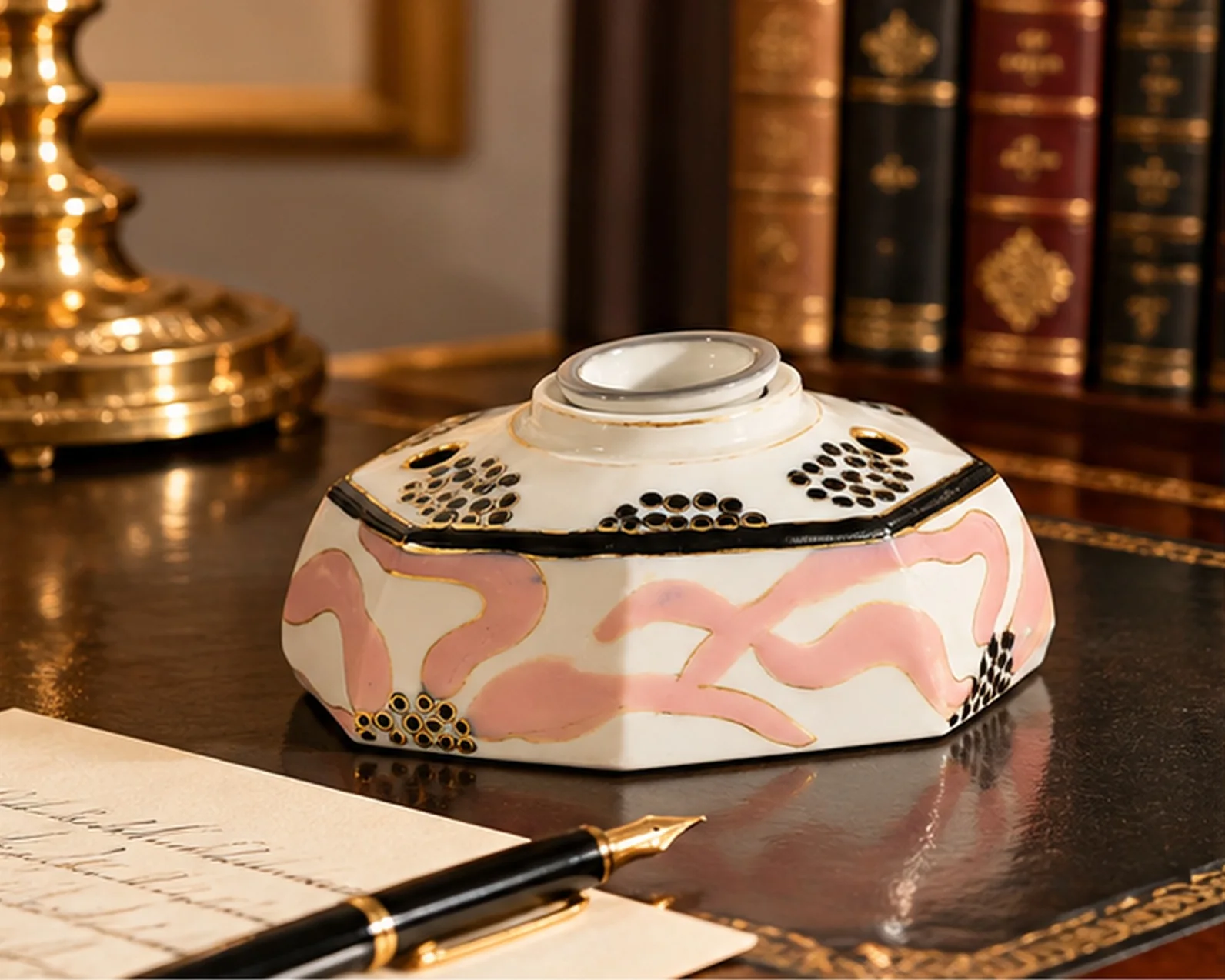
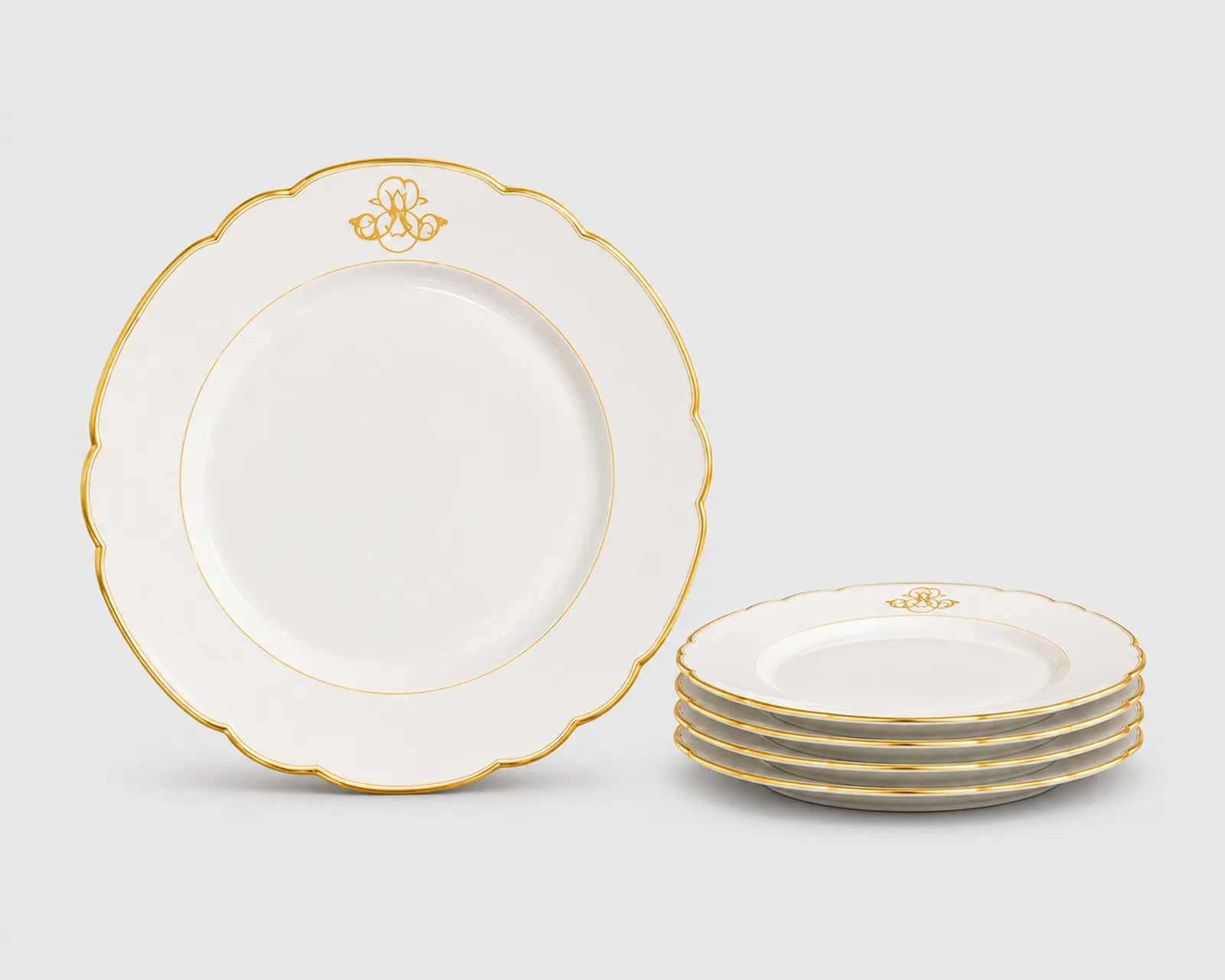
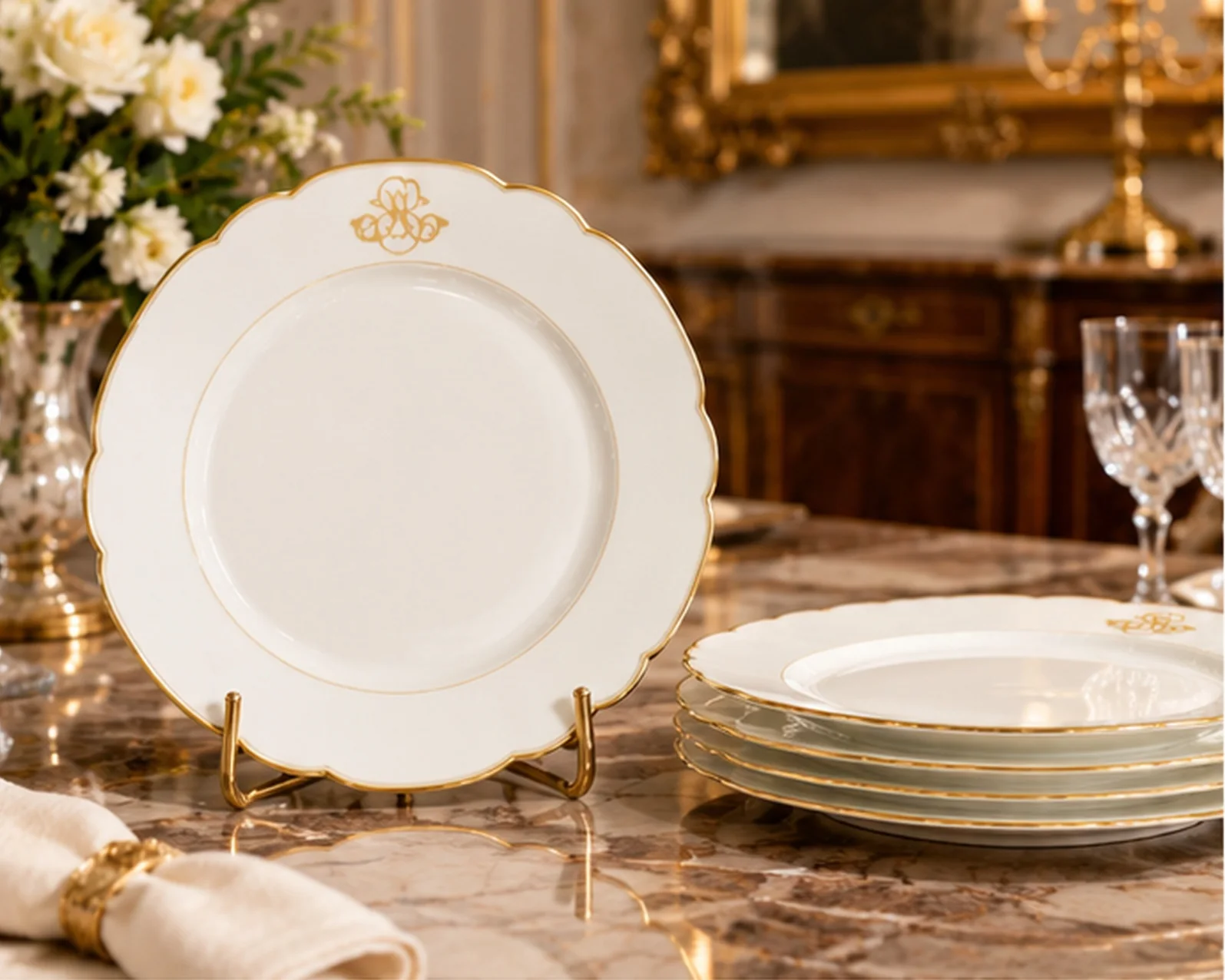
Two pieces in the gallery show the diversity of Limoges. The Art Deco inkwell by Camille Tharaud, from the 1930s, octagonal in shape, combines pink ribbons and black dots ringed in gold, in colours integrated into the glaze that made Tharaud's reputation. The set of four Limoges plates with gold rims, with scalloped edges and a gold monogram, recalls the tradition of services commissioned for a family. More pieces await in our Tableware collection.
Do you own a piece of Limoges porcelain and wonder what it is worth? Send us photos of the piece and its marks through our expertise page. Our gallery in Nice buys pieces and also accepts them on consignment: see our sell an object page.